
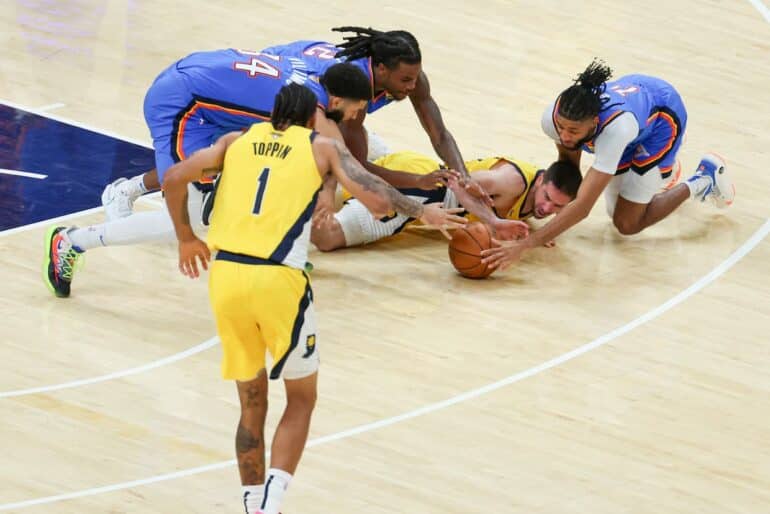
Work smarter, not harder. Any good coach will tell you that. The Indiana Pacers took that maxim to heart in Game 6. As a result, they pulled off an improbable victory to push these NBA Finals against the Oklahoma City Thunder to a do-or-die Game 7 Sunday night.
The Less Pressure, The Better
Despite bringing back almost the exact same team, the Pacers went from the 24th-best defense in 2023-24 to the 13th-ranked one this season (ninth since the calendar flipped to 2025).
A hallmark feature of their defensive renaissance has been picking up opposing ball-handlers full-court, something I’ve discussed here. Doing so bleeds precious seconds off the shot clock and forces teams to initiate their actions far later than they would prefer. As the Seven Seconds or Less Phoenix Suns taught us, the longer it takes you to get a field goal off, the worse it is for your offensive efficiency.
The Pacers ball pressure is going to be a factor always, but especially in this series.
Knicks like to play slow anyways but they start this action at 14 seconds on the clock. pic.twitter.com/avMsa6ZWbP
— Esfandiar Baraheni (@JustEsBaraheni) May 22, 2025
For the most part, this approach has served the Pacers well. It has even yielded positive results at various points in this series against the Thunder. But playing with your foot on the gas like this all the time can take a severe toll on the mind and body, even for one of the most well-conditioned teams we’ve ever seen.
So, in Game 6, the Pacers decided to work smarter, not harder. That meant refraining from pressuring Thunder ball-handlers full-court as frequently, which enabled them to avoid conceding automatic advantages and ramp up their intensity in the half-court.
Look at this possession from late in the first half. Instead of staying in the backcourt after a bucket from Tyrese Haliburton, everyone on the defense hurries back to the other side of the floor. This allows Andrew Nembhard to get set in his stance and properly navigate the screen, affords the hobbled Haliburton more fuel to make necessary rotations/flood the gaps and forces the ball into the hands of Chet Holmgren — a streaky driver when going against physicality.
This change in approach allowed the Pacers to force more turnovers (21) than they had been through the first five games (13.4 per game). On the surface, this seems counterintuitive but it actually makes perfect sense.
Unlike in high school or college, where full-court pressure is used to generate more turnovers, NBA teams don’t deploy this tactic in the hopes of generating more steals; Indiana was 12th in turnover rate this year, despite pressuring teams full-court more than anyone else, Per Synergy Sports.
One thing @motorcityhoops and I have talked about all series for Indiana is them utilizing lower pick-up points on D in order to shrink the court for OKC. Finally have done it here in Game 6 while upping ball pressure in the halfcourt, and OKC hasn't dealt with it at all.
— Sam Vecenie (@Sam_Vecenie) June 20, 2025
As I noted earlier, full-court pressure is used to delay the start of a team’s offensive actions. However, NBA ball-handlers are too talented to consistently get ripped by over-aggressive defenders, and great ones — like Shai Gilgeous-Alexander and Jalen Williams — can use these gambles to blow by guys and create power plays offensively.
So, by scaling back their full-court pressure, the Pacers gave themselves a chance to properly align their militia in the half-court, where they could focus their efforts on rotating and digging at the ball to create chaos. It’s a trick the Minnesota Timberwolves utilized in their Game 3 curb-stomping over the Thunder during the Western Conference Finals.
More Energy For Offense
The other benefit of not guarding 94 feet is it gives you more energy to throw crisp passes and make wise decisions with the basketball. The Pacers averaged the NBA’s third-fewest turnovers per game (13.2) during the regular season. However, through five Finals contests, the Thunder were luring them into 18.6 giveaways per game.
In Game 6, the Pacers’ offense looked more like the well-oiled machine we’ve all fallen in love with over the last two years and only forfeited 10 turnovers, including two in the first half. This helped them get more shots on goal than Oklahoma City (117 field goals and free throws, compared to the Thunder’s 100). Plus, it took the teeth out of a defense which thrives on getting interceptions for easy run-outs (second in turnover rate during the regular season).
The Pacers also had more gas in the tank to rebound the ball, grabbing 11 offensive rebounds and holding the Thunder to just four. This disparity further contributed to Indiana winning the possession battle handily.
In sports, it can be easy to fall into the mental trap that problems must be fixed by applying more pressure on them — in this case, both figuratively and literally. Through five games, the Pacers were losing the turnover battle (and, to a lesser degree, the rebounding battle). But they didn’t fall for the same traps so many before them have.
The Pacers realized to beat this Thunder team, they needed to stray away from their base defensive identity. Now, they’ re just one win away from their first title in franchise history.