
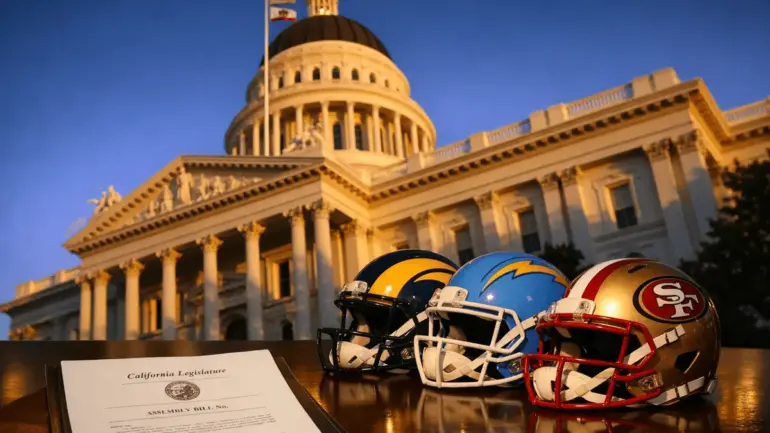
The Los Angeles Rams, Los Angeles Chargers, and San Francisco 49ers are backing California Senate Bill 795 – a proposal that would significantly restrict how professional athletes access workers’ compensation benefits in the state. The bill, authored by Sen. Lola Smallwood-Cuevas (D–Los Angeles), targets cumulative trauma claims and tightens California’s jurisdictional reach over players whose careers stretched across multiple states and franchises. This is not a routine policy footnote – it is a league-business story with direct financial stakes for every NFL franchise operating in a state that has functioned, for decades, as the de facto national forum for sports injury claims.
Here is what this article will do: explain what SB 795 actually changes, why California’s three NFL teams are aligned behind it, and what the NFLPA’s fierce opposition means for the bill’s path forward.
What the California Proposal Actually Covers – and Why Three NFL Teams Are Backing It
California Senate Bill 795 builds on the foundation laid by AB 1309, the 2013 law that barred most out-of-state athletes from filing cumulative trauma claims in California unless they spent at least 20% of their career playing there or fewer than seven seasons elsewhere. SB 795 goes further – tightening jurisdictional access, narrowing the definition of compensable cumulative trauma claims, and pushing toward a uniform “one team, one state” liability model where only the player’s primary or most recent employer’s home state bears workers’ comp responsibility.
The retroactivity provision is the sharpest edge. According to an NFLPA memo obtained by ProFootballTalk, SB 795 would apply to active and pending claims that have not yet been finalized – meaning retired and current players who already filed in California could see those claims voided mid-process. That is not a procedural technicality. That is the financial core of the bill.
The Rams, Chargers, and 49ers are California employers. Their support signals that the league’s employer-side coalition is intact and organized, and that the NFL’s broader push to confine liability to a single-state, single-employer framework has active franchise-level muscle behind it in Sacramento.
Why California’s NFL Teams Are Aligned – The Business and Regulatory Logic
Before AB 1309, California’s workers’ comp system attracted claims from players who had minimal in-state exposure – including stars like Deion Sanders, Marshall Faulk, and Michael Irvin, all of whom filed cumulative trauma claims despite spending the bulk of their careers with non-California franchises. The financial exposure wasn’t abstract: teams could be pulled into long, costly proceedings for injuries sustained years earlier in other states, under other teams’ supervision. AB 1309 curtailed that, and the Wayne Gandy appellate ruling reinforced it by denying California jurisdiction over the Atlanta Falcons entirely.
SB 795 is the next move in that same direction. For the Rams, Chargers, and 49ers, backing the bill is a matter of operational and financial self-interest – capping cumulative liability exposure, limiting forum-shopping by retired players, and locking in the single-state model as permanent state law rather than relying solely on judicial precedent. The broader NFL offseason business environment has made cost containment at the franchise level a recurring priority, and workers’ comp exposure – particularly for brain and orthopedic injuries – represents a long-tail financial risk that front offices take seriously.
This is more 65/35 in favor of the franchises’ position than the coverage suggests. California has already moved once in the league’s direction on this issue, the courts have reinforced that trajectory, and three major market franchises providing active political support is not nothing in Sacramento.
The Honest Pushback – Why the NFLPA’s Opposition Has Real Weight
Here’s the honest pushback: the NFL Players Association is not running a procedural objection. In an April 2025 statement, the NFLPA said it “strongly opposes California SB 795, which would significantly restrict professional athletes’ access to the workers’ compensation system,” adding that the bill “targets our players, stripping them of the constitutional rights and legal protections afforded to every other worker in the state.” That framing – workers’ rights, not sports labor esoterica – is politically potent in a Democratic-controlled California legislature.
Sen. Smallwood-Cuevas represents a Los Angeles district and has deep ties to labor organizing. The bill’s author backing a measure that the state’s largest union for professional athletes calls unconstitutional creates a real political tension that is not easily resolved by franchise lobbying alone. The retroactivity provision in particular is a vulnerability – amendments softening that clause are possible, and if they materialize, they signal that opposition pressure is landing.
The counterargument is real. But the 2013 precedent – when the NFL, MLB, NBA, NHL, and MLS all aligned against California’s open forum – shows that multi-league employer coalitions can move California on this issue. The NFLPA is fighting uphill.
What Happens Next – The Legislative Checkpoints That Resolve This Story
SB 795 will move through committee hearings and floor votes in the California Legislature before it can reach the governor’s desk. The lobbying pressure from both sides will intensify as that timeline compresses. Watch for any amendments addressing the retroactivity provisions – that is the bill’s most legally exposed flank, and softening language there would signal that opposition from the NFLPA and player-side attorneys is influencing the drafting process.
Watch for whether other leagues – MLB, NBA, NHL – formally join the NFL’s franchise coalition in support, replicating the multi-sport alignment that drove AB 1309 across the finish line in 2013. And watch for the governor’s office signaling a position: California’s governor will face competing pressure from labor allies and major-market sports franchises, and any early indication of where that calculation lands will tell you whether SB 795 has a real path to becoming law. For continuing coverage of this story and other major NFL franchise business moves, keep it locked to Sportscasting.com.
Bottom Line
California SB 795 is the NFL’s employer coalition taking another step toward a permanent single-state, single-employer workers’ comp framework – and three of the league’s highest-revenue franchises are providing the political spine behind it. The financial logic is clear: limit cumulative trauma liability, end forum-shopping, and shift long-term injury costs away from franchises that may have employed a player for only a portion of his career. The NFLPA’s opposition is serious and politically well-positioned, but the 2013 precedent shows this fight is winnable for the league side. The retroactivity provision is the bill’s live wire – watch how Sacramento handles it.