
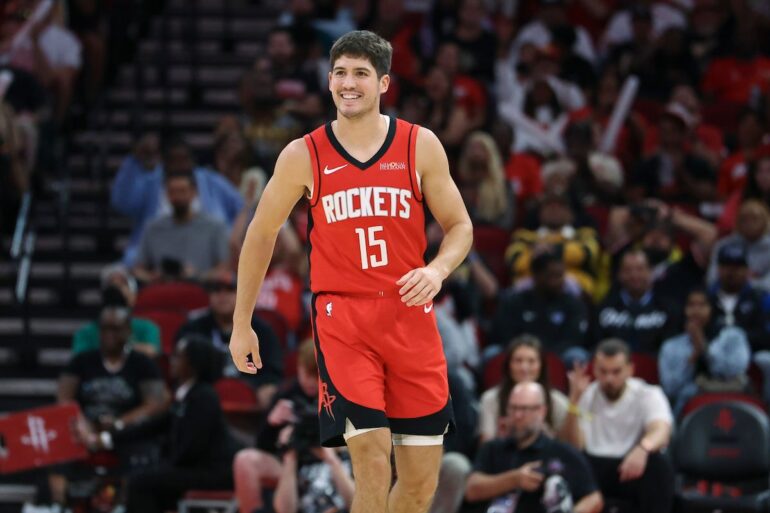
Even in an underwhelming 2024 Draft class, Reed Sheppard’s rookie performance underwhelmed for a third overall pick last season. After starring at Kentucky, his struggles in Houston cast doubt on his status as a future star, especially when the Rockets’ timeline hit hyperdrive speeds after acquiring Kevin Durant this summer.
Fred VanVleet’t torn ACL flipped Sheppard’s sophomore leap from something to hope for to a necessity for contention. And after finishing as one of the league’s worst players as a rookie, Sheppard is breaking out as a sophomore, stepping into the gaping void of Houston’s backcourt
He’s flourishing as a sixth man for a surging Rockets team, averaging 14.3 points, 3.3 assists and 2.8 rebounds on plus-5.4 percent true shooting. Sheppard ranks 29th league-wide in Estimated Plus-Minus (plus-3.2), an enormous jump from his 455th-place finish in 2024-25. Houston’s second-ranked offense has received a major boost from Sheppard’s shot-making.
Through 17 sophomore contests, his 3-point efficiency has ricocheted back to his collegiate levels, splashing an otherworldly 45.1 percent of his triples (12.2 attempts per 100 possessions, 89th percentile volume). As long as he’s converting these shots and sinking nearly half of his catch-and-shoot threes, defenses will commit resources to keep him from taking them.
Processing speed and shot-making touch well beyond the level of most 21-year-olds allow Sheppard to thrive against tilted defenses. He’s generating 1.32 points per possession on spot-ups and Houston thoughtfully implements him as an off-ball mover beyond freelance playmaking.
I’m fond of his application as a screener in inverted ball-screens with Durant or Alperen Şengün, often forcing weak pick-and-roll defenders into actions before he slips out for a three:

Existing without the basketball is always pertinent on a team with offensive superstars but he’s also filled a major initiation void. While Sheppard doesn’t attack the rim (1.9 rim attempts per 100 possessions, 13th percentile) and create against pressure like a star guard, white-hot off-the-dribble shooting fuels his pick-and-roll scoring (81st percentile in points per possession).
Compared to his rookie campaign, Sheppard’s on-ball scoring and creation are his greatest areas of growth. On isolations, pick-and-rolls and post-ups, his true shooting has increased by 17.8 percent from his rookie to sophomore season. He’s excelling as a secondary ball-handling option in an otherwise barren guard room.
Sheppard isn’t a high-volume passer, ranking in the ninth percentile in potential assists per 100 possessions (9.4). But he compensates for his limited handle and live-dribble passing skill with scorching midrange shooting, currently sinking an elite 55.9 percent of his 2.1 short midrange shots per game.
A once-timid Sheppard no longer shies away from firing threes or knifing into the defense to find his shots. He ranks fifth in effective field goal percentage (56.8 percent) among 79 players with at least 50 pull-up jumpers.
Reed Sheppard pullup shooting pic.twitter.com/MZcogLGZaL
— bjpfclips (@bjpfclips) December 1, 2025
Upgraded offense supplants his already impressive defense, which he’s only honed as a sophomore. Sheppard’s Defensive EPM currently sits in the 91st percentile (plus-1.4), ranking him fifth among point guards. His sniper hands supercharge Houston’s defense, built on causing chaos and forcing turnovers.
No qualified player (100 or more total minutes) racks up more deflections per 100 possessions than Sheppard (9.0). Preternatural reflexes and awareness let him play well above his height and wingspan on defense, always a threat to turn defense into offense for the Rockets.
Reed Sheppard steals pic.twitter.com/6VXpOfd8Hr
— bjpfclips (@bjpfclips) December 1, 2025
Impeccable hands and instincts drive Sheppard’s turnover creation and defensive impact numbers. He boasts undeniably valuable defensive qualities but offenses already target him on the ball and with screens. In the postseason, sharp offenses will exploit every weak link possible and define players by their limitations.
Despite Sheppard’s stellar forced turnover numbers, Houston’s takeaway rate drops 2.5 percent with the sophomore guard on the floor. He’s played just under 400 total minutes but if this noisy early season data becomes a signal, it might stem from teams already targeting Sheppard.
His 6-foot-2 frame hinders his positional versatility and screen navigation, lacking the stature to hold off larger players and the elite quickness to shut down players of a similar size. His pinpoint hands offer a fighting chance but watch how Houston’s usually rigid defensive shell cracks when Sheppard takes on an unfavorable matchup:
Reed Sheppard targeted defensively pic.twitter.com/WMLBOSWpTG
— bjpfclips (@bjpfclips) November 30, 2025
During Sheppard’s 70 minutes at the two alongside Aaron Holiday, Houston’s turnover creation spikes to an elite 19 percent (4.1 percent above league average). The Rockets force more turnovers when they insert another small point guard who doesn’t force turnovers, likely because of small sample variance, but possibly because providing teams a juicier target to hunt on switches frees Sheppard to star as a help defender.
Regardless of those pivotal defensive minutiae, Sheppard has proven himself a valuable complementary option on a buzzsaw Rockets team. His rookie growing pains are no longer salient; his confidence flipped after a rocky first season. Optimism for his long-term outlook is at a high point but Houston has serious title aspirations this season.
Can Sheppard contribute meaningful minutes in a postseason setting? During their seven-game defeat to the Golden State Warriors last spring, Houston’s offense lacked the spacing to pressure and bend an elite defense. To some extent, Durant is a one-man offense but he’s at his best with a primary playmaker to relieve some responsibility.
Şengün and Amen Thompson absorb some of that load but Thompson especially still has notable dribbling warts. It’s tough to win on offense in the playoffs with as few reliable ball-handlers as the Rockets have but this team is an outlier at its core. Playoff-level defensive aggression and physicality will bother Sheppard yet his-floor spacing alone would loosen the offense.
Maybe, playoff opponents remove him from the game by targeting him defensively and forcing him to score on the interior. If Houston hopes to dethrone the Oklahoma City Thunder and knock off teams like the Denver Nuggets and Minnesota Timberwolves, Sheppard must rise to the moment, just as he’s done to begin the 2025-26 season.