
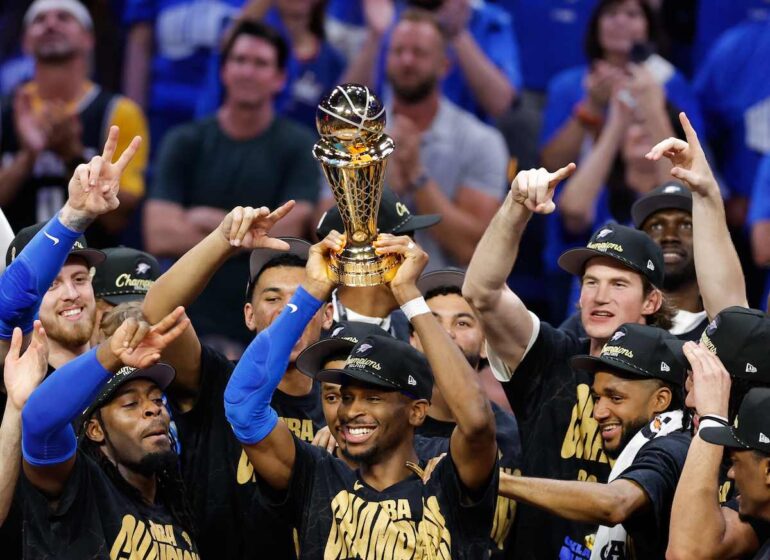
Throughout these NBA Finals — a series the Oklahoma City Thunder won, 4-3, Sunday night to capture the Larry O’Brien Trophy — a defining theme of their story became Shai Gilgeous-Alexander as a playmaker. After the two teams ping-ponged victories to arrive at Game 5 deadlocked 2-2, his passing and its roller coaster presence grew to be a harbinger for the Thunder.
During Game 4, a contest Oklahoma City pried from the Indiana Pacers in comeback fashion, Gilgeous-Alexander notched a goose egg in the assists column. That outing from their offensive nucleus helped minimize the Thunder’s 3-point output. They attempted just 16 triples (3-of-16 shooting) and posted a season-low 3-point rate of 17.6 percent.
A confluence of factors led to those numbers. It was not some scathing indictment of Gilgeous-Alexander’s passing limitations, even if they do exist and shoulder a slice of the blame pie. Andrew Nembhard and the Pacers face-guarded him much of the night, which reduced his touches and on-ball load. In a league where every team increasingly launches as often as possible from deep, Indiana’s defensive scheme intends to take away threes. The Thunder’s spot-up threats were too gun-shy when slight openings did arise.
How Gilgeous-Alexander Adapted In Game 5
Nonetheless, Gilgeous-Alexander bore a responsibility to buck that trend entering Game 5. He’s among the NBA’s foremost offensive talents and drives Oklahoma City’s attack. Particularly culpable or not, he was best-suited to lather up the offense and ease life for everyone.
So, he did precisely that, routinely turning the corner downhill to tilt the Pacers’ defense, getting off the ball when help collapsed and table-setting easy long-range looks. The 2024-25 MVP dished out 10 assists (three turnovers), and the Thunder’s 3-point rate vaulted from 17.6 percent (Game 4) to a still-low-but-more-palatable 29.8 percent (Game 5). They went 14-of-32 from deep and won, 120-109, to nab a 3-2 series lead.
What Changed For The Pacers In Game 6
Three days later, the Pacers, now down 3-2 and facing elimination, opted to amend their strategy against Gilgeous-Alexander. Nembhard — the primary defender on Gilgeous-Alexander — looked less sharp and somewhat worn down in Game 5 from the taxing role asked of him all series. He lost contact numerous times and surrendered space, which rarely happened through four matchups.
Indiana gave him some reprieve and slashed his defensive dojo from 94 feet to 47 feet. They no longer pressured Gilgeous-Alexander full-court, instead electing to shrink the floor and maximize their half-court pressure.
Doing so mitigated Oklahoma City’s high, early screens near the midway line, a tactic consistently flummoxing Indiana’s defense and offering Thunder ball-handlers a catwalk to the paint. As a response, Gilgeous-Alexander and the coaching staff called for more guard-guard screening actions, hoping to engender favorable switches against unqualified perimeter stoppers not named Andrew Nembhard.
But guard-guard screens are nothing new for Oklahoma City’s offense; they’ve been a staple for years. The Pacers were prepared for that sort of trick. When Gilgeous-Alexander broke the semi-circle just below the free-throw line, regardless of whether it stemmed from a guard-guard screen, Indiana brought a second defender toward the 6-foot-6 slinky in sneakers.
That gambit caught Gilgeous-Alexander and the Thunder off-kilter. The Pacers are not one to typically double-team stars, more content to let stars be stars and siphon off the supporting cast’s rhythm. It’s how they most commonly guarded fellow All-NBA honorees like Giannis Antetokounmpo, Donovan Mitchell and Jalen Brunson during the first three rounds this postseason.
Gilgeous-Alexander was perplexed Thursday night. He tied a season-high with eight turnovers, posted a season-worst 29.6 percent turnover rate and tallied only two assists. The 26-year-old repeatedly succumbed to blind-side help and burped up a few ill-advised jumpers amid his worst showing in 23 playoff games. Indiana ran Oklahoma City out of the gym with a 108-91 victory and extended this compelling series to a decisive Game 7.
A Masterful Game 7
Armed with two days off and a full reel of film to dissect, Gilgeous-Alexander was ready for Indiana’s prior defensive adjustments and countered with his own in Game 7. Despite a frigid 8-of-27 shooting line, he was superb as a facilitator. His 12 assists and 60 percent assist rate both tied season-highs and were complemented by a frugal one turnover (2.7 percent turnover rate, second-lowest of the playoffs).
I am not a Shai Gilgeous-Alexander historian privy to the details of every NBA game the man has played. Yet given the magnitude and output, it feels entirely possibly Sunday represented the finest playmaking performance of his career. When a second Pacer approached his orbit from behind, he calmly located open shooters above the break — a stark change from Game 6’s pitfalls:
As Game 6 progressed, he appeared more and more unnerved by Indiana’s defensive tweaks, which threw his processing out of wack and warped his decision-making for the worse. From my vantage point, it capsized on this play below. When a delicate changeup was required, he rifles a fastball to Isaiah Hartenstein and records his seventh turnover of the evening.
He’s sped up and off-balance, and the pass seems more like a last-ditch guess than a composed answer to what the Pacers are showing him — a through-line for many of his Game 6 foibles.
Gilgeous-Alexander’s pick-and-roll passing corrected course Sunday. For the first time all series, he assisted both Hartenstein and Chet Holmgren on restricted area buckets via ball-screens. Less imposing coverage from Indiana certainly aided his efforts. But they were natural, seamless reads for an initiator who’s not always shown total comfort as a pick-and-roll distributor, more wired to dialed his own number — a generally warranted preference, given his immense scoring exploits.
He saw space about to be populated by his big men — that which was carved out by the attention he commands himself — and promptly fed them for baskets. Stuff like this is among the next steps in his evolution, developments primed to make life rosier for everyone wearing Thunder blue and orange.
It absolutely did for a night, and will extend into an entire summer of championship-fueled elation.
Just as Gilgeous-Alexander’s poise evaporated during Game 6, the opposite occurred in Game 7. He continually executed sage passing reads to build rhythm, bravado and confidence. Whereas heat checks are largely associated with scoring binges, his manifested elsewhere.
These two assists resonated, emblematic of a superstar in a flow state completely aware of how to puncture the defense standing before him. Whew, that’s good stuff!
Game 7 was not flawless for Gilgeous-Alexander. He went 3-of-15 in the second half, filled with plenty of shaky shots, particularly in the fourth quarter, as Oklahoma City shifted to an overly conservative, prevent offense down the stretch. On many nights, 8-of-27 shooting might spell doom for his offensive impact. It didn’t Sunday.
Through various means, he thrived as a playmaker, setting series-highs in assists (12), potential assists (22) and passes made (48), per NBA.com. Three days earlier, in a lifeless defeat, he labored, with two assists and eight potential assists. Three days before that, in a convincing win, he flourished, with 10 assists and 15 potential assists.
For the Thunder, the back half of these Finals were written by Gilgeous-Alexander’s passing. In their loss, its absence and woes sunk them to the brink of elimination. In their triumphs, its splendor uplifted everyone.
He is perhaps the game’s greatest bucket-getter, the superlative trait headlining his brilliance and the reason he earned both the MVP and Finals MVP trophies this year. But his playmaking is why he and all his teammates will soon have their names inscribed on shiny, well-deserved rings that read: Oklahoma City Thunder, 2025 World Champions.