
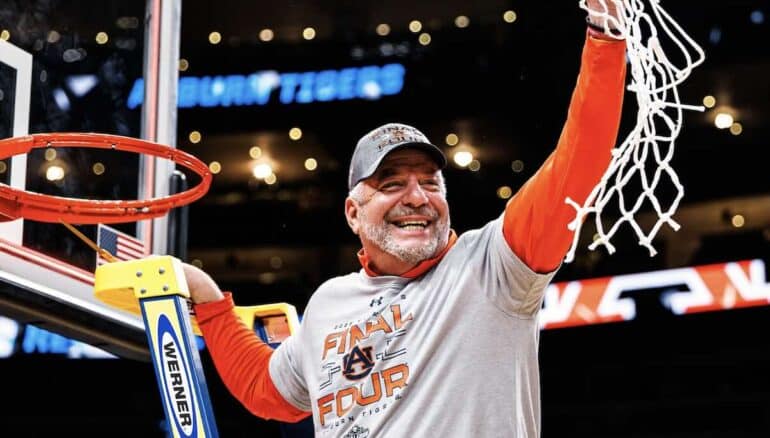
Less than six weeks before the tip off of the 2025-26 college basketball season, Auburn basketball coach Bruce Pearl announced his retirement. While the news came as a surprise to many, the timing of his announcement raises some questions about the motivation behind his decision.
Not only did Pearl help open the door for his son, Steven Pearl, to become his successor, but he provided him with invaluable job security — a five-year deal without any previous head coaching experience.
By announcing his retirement just 42 days before the start of the season, Pearl also put the university and his players in a peculiar spot.
Auburn was no longer in a position to conduct a realistic coaching search to hire candidates from the outside, and though players will receive a 30-day transfer portal window, many of the top teams in the country no longer have spots for them on the roster. Plus, with school already underway, limited availability for classes poses a problem for players hoping to graduate.
Below, we’ll break down the politics behind the timing of Bruce Pearl’s retirement in more detail and explain why it was more strategic than you might think.
Strategic Timing Leaves Players Without Many Options
This isn’t the kind of decision that coaches make on a whim, especially one as experienced as Pearl.
At age 65, he leaves the program as the winningest coach in Auburn history and led the program to its only two Final Four appearances. And while several reports linked Pearl to the vacant senate seat in Alabama, Pearl already refuted the rumors and said that he won’t be running in the 2026 Alabama Senate race.
Yet, his decision to announce his retirement in late-September still comes off as a strategic move that restricts player movement and gives his son Steven the best shot at kicking off his tenure with a successful season.
Pearl left his son with a competitive roster that ranks among the top 15 teams in the country. The Tigers brought back NBA hopeful Tahaad Pettiford. Auburn had one of the top transfer portal classes in the country heading into the year, led by Keyshawn Hall from UCF, KeShawn Murphy from Mississippi State, and D-II Player of the Year Elyjah Freeman. The Tigers also have a strong incoming recruiting class, including blue-chip prospects Kaden Magwood and Sebastian Williams-Adams.
Players have 30 days to transfer following Pearl’s retirement, but most schools have already started practice in preparation for the start of the season. Very few schools have spots on the roster, let alone enough NIL money to bring in new talent, meaning players are likely better off staying put and seeing this transition through, at least for this year.
Even if players do transfer, graduating becomes even more difficult now that classes are underway. Limited availability in classrooms will also be a deterrent for players who want to graduate elsewhere.
Succession Planning and Leverage
The move to have his son be his successor at Auburn appears to have been years in the making.
Two years ago, Steven Pearl was announced as the associate head coach. He most recently served as the program’s defensive coordinator and is credited with recruiting efforts, including landing and developing players like Johnni Broome, Walker Kessler, and Miles Kelly.
While he’s been an assistant under his father since 2014, he has never been a head coach at any level, making the decision to give him the long-term security of a five-year deal even more interesting.
And while Auburn is spinning the hire as a sign of continuity, stability, and rewarding a longtime assistant who already knows the system and the recruits, what choice did the program really have?
At this stage in the offseason, hiring from the outside would have been nearly impossible. Auburn wasn’t able to conduct a thorough head coaching search during the offseason to find a long-term successor. The best candidates have already moved on and have been hired elsewhere.
Applying the interim tag to Steven’s job wouldn’t have been wise either, as it would have been a clear signal to current players and future recruits that change could be on the horizon.
In order to preserve its reputation and keep players from leaving the program, a long-term deal was a necessary part of the transition.
Pearl’s Retirement Was His Final Power Move
Highly touted Auburn transfer Elyjah Freeman reacts to Bruce Pearl’s shocking retirement: pic.twitter.com/ORHMCuutuQ
— College Basketball Content (@CBBcontent) September 22, 2025
Pearl’s exit from the program also comes at a time when he had the most leverage.
Auburn is coming off of its second Final Four appearance in program history. The program has been on an incredible run since the 2017-18 season. Since then, Pearl has led the Tigers to the NCAA Tournament in six of the last seven seasons, won three SEC regular season titles and two SEC Tournament titles.
The timing of his exit allowed him to keep his Auburn legacy alive through his son, who will get a chance to coach a top-25 basketball team without moving his way up the coaching ranks. Very few first time head coaches can land a job at a Power Four program, let alone one with national title aspirations. Yet Pearl managed to get his son into the mix without having to interview for the job or compete with outside candidates and got him a five-year deal to go along with it.
It also forces players to stay and play at Auburn for at least this season, giving his son the best chance to hit the ground running as a head coach.
In the end, Pearl’s retirement was his final power move, locking in his legacy and ensuring his family’s grip on Auburn basketball for years to come.