
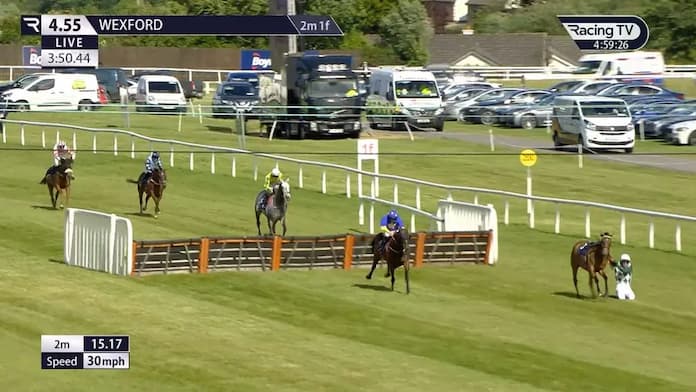
Philip Byrnes has been cleared of deliberately falling from race leader Redwood Queen during a hurdle meeting at Wexford on May 28 last year.
A referrals committee of the Irish Horseracing Regulatory Board (IHRB) has decided that Byrnes was unseated due to “poor horsemanship”.
Byrnes had won five of the previous nine races in which he had ridden the mare, so the dramatic nature of his surprise exit caused an outcry on social media.
Redwood Queen was trained at the time by Charles Byrnes, the jockey’s father.
What Was The Controversy Over The Wexford Fall?
Redwood Queen’s price had drifted alarmingly ahead of the 2m 1f Wexford Claiming Hurdle race, lurching from 13/8 to 13/2.
At the same time Beacon Edge moved from around Evens to a 1/3 hot favourite.
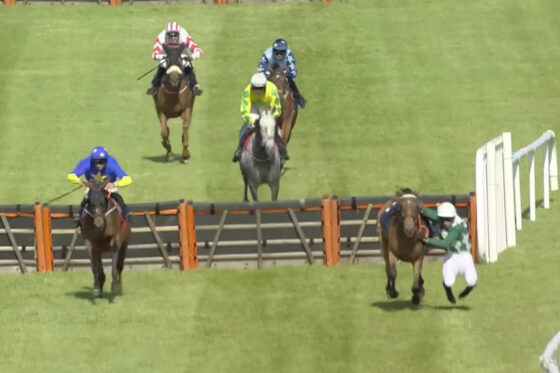
Coming to the last, Redwood Queen had clean air ahead of Beacon Edge, who was running in second.
The jump was good, but Byrnes’ left foot appeared to become dislodged from his stirrup, and he was ejected from the saddle to the left of his mount.
His actions were questioned by TV coverage at the time and discussed over social media.
A day after his Wexford fall, Byrnes was informed that the IHRB was going to review the race.
In October the Board revealed that Charles and Philip Byrnes would appear in front of a referrals committee to give their account of what had happened.
That resulted in a formal hearing on December 15 in front of Justice Peter Kelly, Martin O’Donnell and John McGuire.
Witnesses At The December Hearing
The hearing took place at IHRB headquarters and lasted for just over 10 hours.
Eight witnesses were called to present their views and race footage from different angles was available for scrutiny.
Two-time Grand National-winning jockey Leighton Aspell testified that he thought the fall was a “deliberate act”.
Equestrian John Watson’s opinion was that Byrnes had “made a good effort” to stay on his mount.
This was backed up by former champion jockey Davy Russell who “disagreed wholeheartedly” with the allegation Byrnes had bailed out.
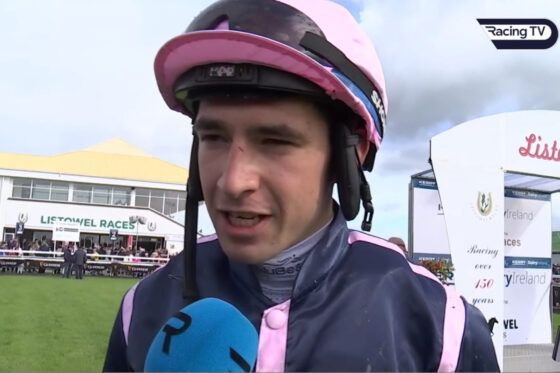
The Raceday Stewards’ report confirmed that the incident had been reviewed but no Stewards’ Enquiry was felt necessary.
Reference was also made to an interview with the jockey in August 2025 in which he described the incident.
“I went to the last… got a bit short at it.
“Just miscommunication between horse and rider.
“She came up underneath me, caught me on the backside, and I came off.”
Verdict From The IHRB Referrals Committee
The IHRB Referrals Committee concluded that neither Byrnes nor his father had any case to answer.
“We are unable to identify any motivation to justify him deliberately dismounting from the horse.
“We accept what was said by Mr Russell to the effect that jumping off can give rise to the worst type of fall and that the general rule is that one does not bail out for fear of the injury that might ensue.
“Had the fall been deliberate, we believe the jockey would be fully aware of the embarrassment that that would be to him, and the consequences for his reputation as a jockey.
“We also dismiss any suggestion that betting or betting patterns formed a motivation for the fall.
“We found the jockey’s evidence on this element convincing, and the betting pattern evidence which was furnished to us to be unsatisfactory and unconvincing.
“The IHRB complaint of deliberate conduct on the part of the jockey is not made out.
“We are of opinion that what occurred on this occasion was an example of poor horsemanship on the part of the jockey, consistent with his pre-existing poor falls record.
“In our opinion on the occasion in question the jockey’s position of instability stemmed from an exuberant jump by the horse, resulting in the loss of both irons consecutively.
“His effort to remain on board by holding on to the reins and neck strap was unsuccessful.”