
With no NBA games and little free agent news to buzz over, a popular exercise among NBA diehards is predicting how many wins teams are in store for this 2025-26 regular season.
In my experience, these discussions are often more complicated than necessary. What I mean by this is you really only need to ask yourself two questions: how good will their offense be and how good will their defense be?
Great offenses have a certain floor while poor defenses give teams a hard ceiling. What are those specific numbers? Well, that is what this article is for.
Here, we’ll take a look at every top-five offense/defense (105 teams) and every offense/defense to finish 26th-30th (102 teams)* in offensive/defensive rating since 2001-02 to see what kinds of seasons those teams tend to have. After that, we’ll use the data we gathered to identify some teams in line to over/underperform their preseason expectations.
*There are three fewer bottom offenses/defenses than top ones because the NBA didn’t add its 30th team, the Charlotte Bobcats, until 2004-05.
What Does History Say?
Let’s start with top-five offenses and defenses. Having a top-five offense or defense usually indicates a very good team. Of the 105 top offenses we looked at, they averaged 54.5 wins in the regular season. Meanwhile, top defenses won an average of 53.4 games.
Being a great defense provides a slightly higher floor, as 97.1 percent of top defenses won at least 40 games (compared to 96.2 percent among top offenses). Nowadays, that’s typically good enough to compete for a spot in the Play-In Tournament, which began in 2020-21 (as currently constructed).
However, being a great offense provides a higher ceiling. According to our study, 24.8 percent of top offenses won at least 60 games, compared to 21 percnet for top defenses.
Achieving both a top-five offense and defense basically guarantees title contention — 100 percent of those 21 teams won over 55 games. The lowest win totals in this group were the 2022-23 Boston Celtics and 2023-24 Oklahoma City Thunder, which both won 57 games.
As for the bottom-tier offenses and defenses, being a bad offense seems to be more of a death blow than having a bad defense. Among the 102 teams we looked at, only 5.9 percent of bad offenses won at least 40 games while 9.8 percent of bad defenses surpassed this milestone.
Furthermore, the most wins a bottom-tier offense has won in this span is 48 games (the 2013-14 Chicago Bulls). On the flip side, it has been possible to eclipse 50 wins with a bad defense. The 2003-04 Dallas Mavericks (52 wins), 2004-05 Seattle SuperSonics (52) and 2017-18 Cleveland Cavaliers (50) all achieved this feat, the last of which even made the NBA Finals that year.
However, to overcome a bad defense, a team must be elite on the other side of the ball. All three teams cited above were top-five offenses, with the Mavericks and SuperSonics finishing top two in that category.
It basically goes without saying, but being a bottom-five team on both ends of the floor results in automatic cellar status. No team has ever been a bad offense/defense and won more than 27 games, and 51.6 percent of those teams failed to win 20 games.
Projected Overachievers
Based on these numbers, let’s look at some teams to be possible over/underachievers. I’ve already talked about this year’s Dallas Mavericks in pretty deep detail. I think they have elite defensive personnel and could easily see them being a top-five defense While BetMGM currently has their over/under at 39.5 games, history favors them exceeding 39 wins pretty easily (88.6 percent of top-five defenses win at least 45 games).
Speaking of elite defenses, the Portland Trail Blazers had the NBA’s sixth-best defense in 2025 and all they did this offseason was sub out one of the worst perimeter defenders in the NBA (Anfernee Simons) for one of the best of his generation (Jrue Holiday). BetMGM has their over/under at 34.5 games, but I think they should be able to get to 40 wins.
The only top-five defenses since 2001 to not reach 40 wins were the 2001-02 Miami Heat (36 wins), 2010-11 Milwaukee Bucks (35 wins) and 2012-13 Washington Wizards (29), and none of those teams finished higher than 27th in offensive rating. The Blazers were 23rd in offensive rating in 2024-25 and their offense should only get better as youngsters Deni Avdija, Scoot Henderson and Shaedon Sharpe age into their primes.
When the Bucks went 10-4 without Damian Lillard to close the 2024-25 regular season, they did it on the back of their offense, finishing fifth in offensive rating in that span. That was without the offseason additions of Cole Anthony and Myles Turner to help amplify the floor-spacing around Giannis Antetokounmpo. I could see Antetokounmpo winning his third MVP award next season and leading the Bucks to a top-five offense in the process. If he does, that gives his team an 89.5 percent chance of winning at least 45 games (their over/under is 42.5).
Projected Underachievers
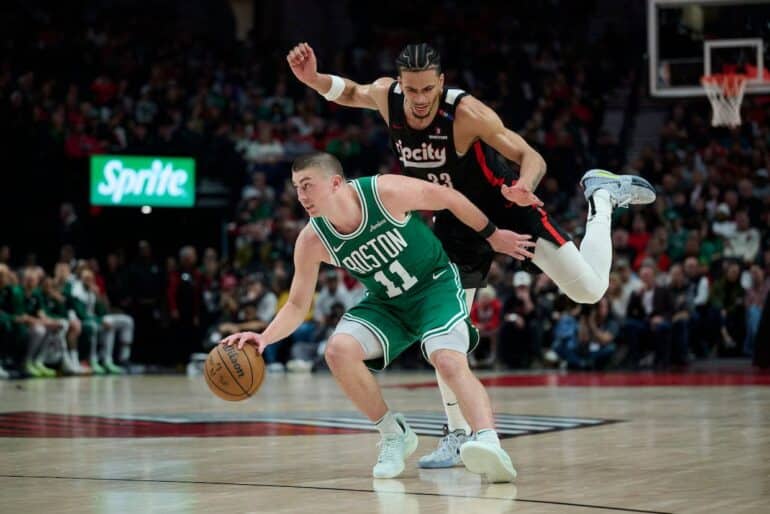
The Boston Celtics finished fourth in defensive rating last season. Yet, in an effort to shed salary, they parted ways with their three best rim protectors (Kristaps Porzingis, Al Horford and Luke Kornet). They’ll also be without Jayson Tatum, one of the best defensive forwards in basketball, for the entire season. On top of that, they were on the other side of the Blazers trade we highlighted earlier, shipping out Holiday in exchange for Simons.
All those variables (plus their potential incentive to tank) tell me their once-great defense could be a bottom-five unit this season. If that happens, they would need a heck of an offensive effort (at least top five in offensive rating) to exceed their projected 42.5 wins, something that seems improbable without Tatum.
The Houston Rockets may have just had the best offseason in the entire NBA and very well could replicate their fifth-ranked defense in 2025-26. But like we said earlier, an elite defense on its own isn’t enough to be a top-tier team, which is what their 55.5 over/under total has them pegged as. They’ll also need a strong offense.
Of the 45 top-five defenses to finish with at least 56 wins, 35 of them (78 percent) were among the top 10 in offensive rating. In total, the average offensive rating of all 45 teams was seventh. After finishing 12th in offensive rating last year, the Rockets aren’t theoretically far from that mark, especially with the addition of Kevin Durant. But I still have serious questions about their on-ball creation and I think Durant’s lack of physicality hurts their offensive rebounding ability, which was a big part of their above-average regular-season offense last year.
Speaking of concerning offenses, the Toronto Raptors finished 25th in offensive rating last season. Yes, they are now officially integrating Brandon Ingram into the mix. But even then, I am unmoved by this unit because of their poor spacing and rim pressure.
Last year, they were 29th in rim accuracy and 22nd in 3-point percentage (per Cleaning the Glass). Ingram, for all his strengths as a player, does little to amplify those two areas. Couple that with their lack of depth — who do you really trust outside their starting five? — and you have the makings of a potential bottom-five offense in 2025-26.
To overcome a bottom-five offense and still reach 38 wins (their over/under is 37.5), the Raptors will likely need close to a top-10 defense.* Based on their current personnel, I don’t deem that highly probable.
*Among the eight teams in our database with bad offenses that still managed to win 38 games, seven of them finished 11th or higher in defensive rating. The only exception is the 2005-06 New Orleans Hornets, which finished 18th in defensive rating.
All data for this article was pulled by Fran Huzjan (@FHuzjan on Twitter).