
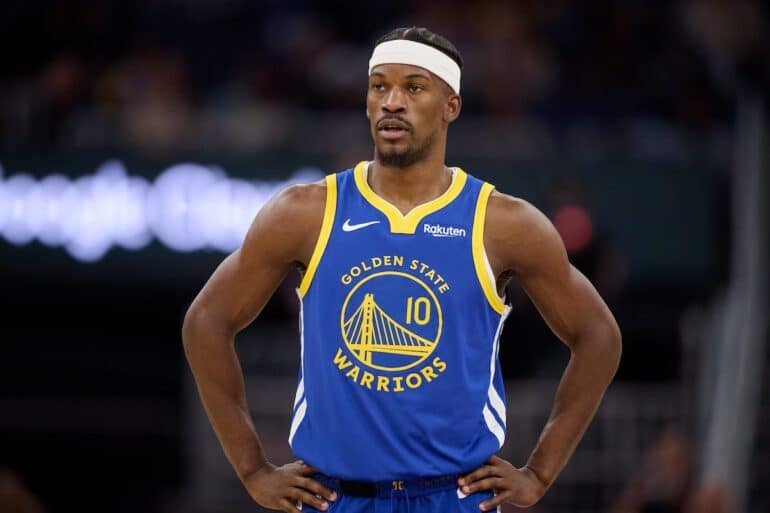
Back on Nov. 13 against the San Antonio Spurs, a non-Stephen-Curry lineup consisting of Brandin Podziemski, Will Richard, Moses Moody, Jimmy Butler and Al Horford was employed. Sans Butler, every member of the lineup was capable of shooting the ball from deep and therefore capable of creating space with which Butler could work.
Even if said floor-spacers opt to remain stationary, Butler’s ability to put the ball on the floor and make a decision is often enough to budge defenders off of their spots, force help off of one or multiple shooters and allow Butler to spray the pass to the open man. Against a defense placed in the proverbial blender, this sequence of events creates a conundrum, as evidenced by the aforementioned lineup against the Spurs.
With Butler driving against the Spurs’ Keldon Johnson and getting into the paint, the rest of the defense is forced to rotate:

Victor Wembanyama helps off of Horford, making Butler’s decision to pass to the corner an easy one. With Stephon Castle rotating toward Horford, the Dominican big man makes the extra swing pass to Richard, who is shooting 38.7 percent on 6.1 3-point attempts per 75 possessions.
Butler being able to create off of his isolation attack has empowered head coach Steve Kerr to change the makeup of his offense during Butler-only minutes to one that is nigh unrecognizable and entirely different from his typical motion offense fare, one that has had Curry as its central fulcrum. Kerr made this change almost out of necessity, a recognition of the fact Butler needs the ball in his hands as much as possible as the main decision-maker and sole advantage creator.
This lies anathema to the notion Kerr has made little-to-no tweaks with regard to how he runs his offense. Perhaps, there has been little-to-no change whenever Curry is on the floor and there hasn’t been the need to do so. However, with Curry on the bench alongside Draymond Green, Kerr has accommodated Butler’s talents to an unprecedented degree.
The Offense Under Jimmy Butler
With Butler often stationed on one of either blocks — posting up with his back to the basket or facing up in a triple-threat position — the alignment of the other four Warriors’ players can be configured in one of two ways.
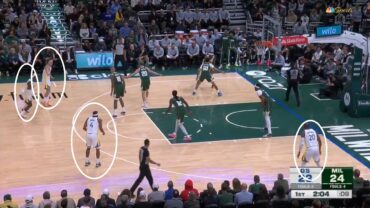
The first alignment involves everyone spacing beyond the 3-point line, ready to catch a pass if and when their man rotates in help toward Butler:
The other alignment — deployed when one non-shooter is on the floor — involves a man in the opposite dunker spot. Having a teammate stationed there makes it difficult to send immediate help in the form of a double or rotation against a Butler drive:
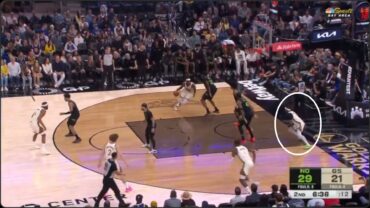
Whenever the dunker-spot alignment is used, there has been one consistent rule followed: whoever is at the dunker spot must move toward the opposite dunker spot at the same time as Butler drives to the basket. In the image above, Gary Payton II is in motion as Butler starts his move toward the paint. With Butler drawing attention toward him, Payton’s move toward the left dunker goes unnoticed:

Occasionally, this dunker-spot alignment is employed, despite having four shooters on the floor around Butler. In the possession below, Quinten Post sauntering along the baseline as Butler drives to the basket induces enough hesitation for Butler to finish the layup without much resistance:

But more often than not, four capable shooters surrounding Butler means the dunker spot is left unoccupied, with the weak-side corner instead filled by a big man who can drill a 3-point shot (such as Post and/or Horford):

The Numbers Favor Butler-Only Units
Per Databallr, Warriors lineups with Butler as the main offensive fulcrum (that is, without Curry and Green on the floor) have not only outscored opponents by 13.8 points per 100 possessions — it has excelled mightily on offense, to the tune of 121.4 points per 100 possessions. That figure bests the Warriors’ season-long figure of 115.7 points per 100 possessions (16th in non-garbage time, per Cleaning the Glass).
As of late, Kerr has attempted to remove the possibility of pairing Butler with a non-shooter and committed to providing him with maximum floor-spacing and shooting personnel. Experimenting with a double-big lineup consisting of Post and Horford against the Milwaukee Bucks, Kerr has had Butler run spread pick-and-roll possessions with Horford as the screener to set Butler loose downhill:

Note how the Bucks opted not to send help against Butler’s drive, wary of the possibility Butler may kick the ball out to one of Richard, Post and De’Anthony Melton on the perimeter. Horford’s flat-angle screen also deserves to be lauded, allowing Butler to drive downhill against an out-of-position Bobby Portis.
This configuration also works wonders with Butler off the ball. During the Warriors’ 13-0 run against the Sacramento Kings in the third quarter on Friday, a ghosted drag screen by Horford draws two toward Butler, who passes to Horford on the wing. A basket cut by Butler, accompanied by a cut toward the dunker spot by Richard (similar to the dunker-spot rule during cleared-side Butler isolations), creates an easy layup for the rookie:

The timely reemergence of veteran stalwarts, Horford and Melton, has also benefitted Butler-only lineups. After hovering around 15 percent on threes, Melton has been shooting 13-of-27 from beyond the arc over his last five games, enough to bring his season-long percentage to 30 percent. As a career 36.5 percent marksman, there is still plenty of room for that percentage to increase, with Butler’s rim pressure and playmaking being key drivers behind that potential uptick.

For an offense often described as complicated and requiring plenty of basketball feel, Kerr has opted to simplify his approach with Butler as the main character. That’s not because Butler requires simple reads and “dumbed-down” offense to excel — far from it, seeing how he has adapted to the Warriors’ standard motion offense, helped by his time with a similar offense under Miami Heat head coach Erik Spoelstra — but because it brings out the best tenets of a Butler-led offense.
His playmaking and decision-making chops, along with the requisite personnel surrounding him, have coaxed the best offensive sequences out of a team that has, in the aggregate, been a disappointingly mediocre offensive squad.