
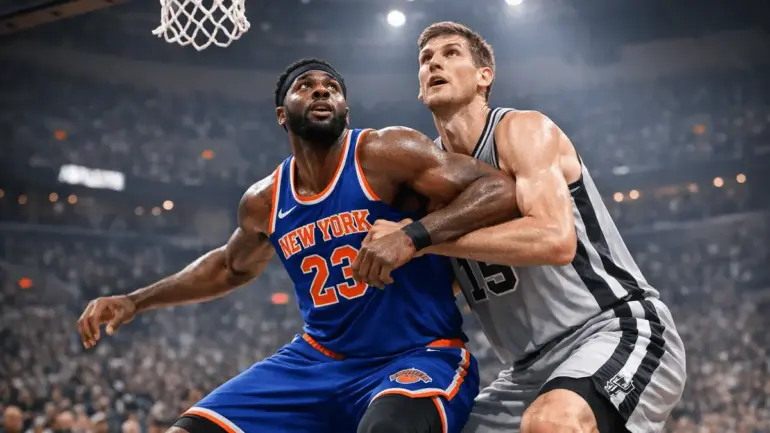
Mitchell Robinson‘s technical foul from Game 2 of the NBA Finals has been rescinded, per NBA on Prime reporter Chris Haynes – and for a player who returned from stress-fracture finger surgery just a week before this series began, that ruling carries consequences well beyond the standard post-game cleanup. The league confirmed the call, which occurred at 4:56 of the second quarter during a physical exchange with Victor Wembanyama, did not meet the threshold for a technical upon review. That distinction matters for the Knicks‘ roster math in ways the original whistle threatened to complicate.
What Actually Happened – The Full Sequence
The sequence unfolded mid-second quarter in Game 2, when Robinson and Wembanyama got tangled in what most observers – and ultimately the league itself – characterized as a routine physical exchange between two bigs. The crew assessed Robinson a technical on the spot. What made the call immediately controversial was the nature of the contact: multiple analysts and fans noted that the interaction looked more like the standard shoving that goes uncalled in playoff basketball than a punishable provocation, and that if anything, a double technical or no whistle at all was the more appropriate response.
The league used its standard post-game review process – the same mechanism that also feeds into Last Two Minute Reports – and concluded the contact did not rise to a technical foul. The official NBA PR communication specified the exact game, quarter, and timestamp of the rescission, announced the following day. Haynes reported the rescission, with the league’s language framing it as the result of a standard review rather than any external pressure. Notably, the same review window also flagged a late kick-ball no-call involving Luke Kornet – a signal of how granularly officials are scrutinizing every whistle in this series.
Why This Ruling Carries More Weight Than a Standard Technical Rescission
This is not a housekeeping decision. It is a protective ruling that directly affects how much Robinson can be deployed as the Knicks’ primary rim deterrent against the most physically unique center in the league. Robinson returned from a stress-fracture finger surgery just before the Finals began – meaning every accumulation point, whether technical fouls or flagrant points, operates under a tighter margin than it would for a healthy player with a clean disciplinary ledger heading into a playoff run.
Had the technical stood, it would have added a data point toward the automatic suspension threshold that kicks in with multiple technicals during the Finals – a threshold the Knicks cannot afford to test given Robinson’s role as their best answer to Wembanyama’s generational interior presence. The rescission wipes both the accumulation point and the automatic fine, restoring Robinson to a clean disciplinary slate heading into Game 3. That reset is not a technicality – it is the difference between a Knicks front office holding its breath every time Robinson sets a hard screen and one that can deploy him without a suspension shadow hanging over each possession.
The broader officiating signal is equally important. By ruling the contact acceptable playoff physicality, the league has effectively told its officials that Robinson is permitted to meet Wembanyama with that level of force going forward. For a Knicks defense that has to find ways to make Wembanyama uncomfortable in the post and at the rim – a challenge dissected in Wembanyama’s own assessment of his Game 1 performance – that implicit green light is operationally significant.
What’s Confirmed and What Isn’t
What is confirmed: The NBA rescinded Robinson’s technical foul from Game 2 via official league communication, citing its standard review process; the rescission eliminates both the fine and the accumulation point; Haynes reported the decision; and the review also addressed the Kornet kick-ball no-call as a separate officiating flashpoint from the same game.
What is not confirmed: The full scope of any additional disciplinary review stemming from the altercation, whether the league communicated directly with either player or team beyond the public announcement, and whether the officiating crew received any internal guidance on how to handle Robinson-Wembanyama physical exchanges in subsequent games.
What to Watch Next
The immediate checkpoint is Game 3 – specifically how officials respond to the first hard physical exchange between Robinson and Wembanyama in the post or on a screen. The league’s rescission sets a de facto standard, but whether the crew internalizes that signal or tightens the whistle under playoff pressure is a live question. Watch Robinson’s minutes and foul count in the first half; if he’s staying on the floor through contact rather than getting called away from it, the ruling is having its intended effect.
The series context sharpens the stakes further. With the Knicks holding a 2-0 lead, Wembanyama facing mounting pressure to deliver in a must-respond moment, and Robinson now cleared to engage physically without a suspension clock ticking, Game 3 could define whether this matchup becomes the physical battle New York needs it to be.
For the latest on Mitchell Robinson, the New York Knicks, and the NBA Finals, keep it locked to Sportscasting.com.