
Canada’s 2026 FIFA World Cup opening ceremony is set for June 12, 2026, at BMO Field in Toronto, beginning 90 minutes before kickoff.
The onfirmed performer lineup includes Michael Bublé, Alanis Morissette, Alessia Cara, Jessie Reyez, William Prince, Nora Fatehi, Vegedream, Elyanna, and Sanjoy.
The ceremony precedes Canada’s opening match against Bosnia-Herzegovina – the first men’s World Cup 2026 match ever played on Canadian soil. FIFA president Gianni Infantino called the event a “powerful reflection of Canada’s identity.”
This is not a performer list. It is a precisely engineered audience-compounding machine – built to activate multiple non-overlapping demographic communities simultaneously and generate multiplicative rather than additive reach. Every name on this bill serves a structural function that no other name on the bill duplicates.
The stakes are higher than a single match. The Canada World Cup opening ceremony is one of three separate host-nation ceremonies – Mexico City went first on June 11, Los Angeles and Toronto both follow on June 12 – and Canada’s is the one carrying the weight of a nation hosting its first men’s World Cup fixture at home. That historical context amplifies every structural decision in the lineup.
Best US Sports Betting Sites For World Cup Betting
Canada’s 2026 World Cup Opening Ceremony Announcement
FIFA confirmed the full lineup for the Canada World Cup opening ceremony ahead of the tournament, which runs from June 11 to July 19, 2026, across Canada, the United States, and Mexico.
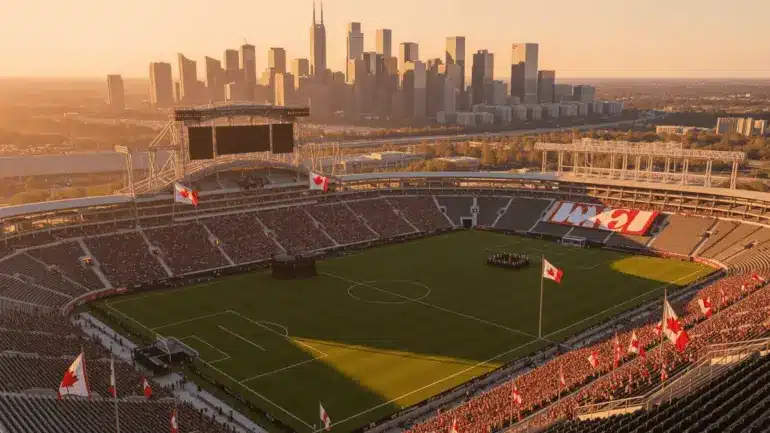
The ceremony at BMO Field – Toronto’s premier soccer venue and home of Toronto FC, with a capacity of approximately 30,000 – begins at 1:30 p.m. ET on June 12, 90 minutes before Canada kicks off against Bosnia-Herzegovina.
Gianni Infantino framed the event explicitly as a cultural statement: “Through music, culture and unforgettable performances, we will welcome the world with a celebration that is uniquely Canadian while also connected to a larger story unfolding across Mexico and the United States. It will be a moment of pride, unity and anticipation as Canada takes its place on football’s biggest stage.”
The full confirmed performer roster for Toronto: Michael Bublé, Alanis Morissette (who will also perform Canada’s national anthem), Alessia Cara, Jessie Reyez, William Prince, Elyanna, Vegedream, Nora Fatehi, and Sanjoy. J
essie Reyez and Elyanna will also perform “Illuminate,” the official FIFA World Cup 2026 track produced by Grammy-winning producer Cirkut.
Will Arnett, acting as a FIFA World Cup 2026 Ambassador, is also part of the pre-match program. For a full breakdown of how to watch all three host-nation ceremonies, the complete viewing guide to the 2026 World Cup opening ceremonies covers broadcast details across every time zone.
Michael Bublé and Alanis Morissette: Why These Two Names Carry This Lineup
Michael Bublé is not on this bill because he is a famous Canadian. He is on this bill because of what he distributes. Bublé commands an audience demographic – mainstream international pop, adult contemporary, entertainment press – that has near-zero overlap with the core football fanbase.
His inclusion activates entertainment media coverage from outlets that would otherwise ignore a pre-match ceremony. It activates older demographics (45+) across North America and Europe who follow him specifically. A
nd it gives the ceremony an international entertainment headline that travels in markets where football already dominates.
Alanis Morissette operates on a different axis entirely. She is one of the most globally recognized Canadian artists alive – her audience is women 35-55, 90s rock nostalgia communities, and mainstream North American music media.
She activates an entirely separate press ecosystem: music publications, pop culture sites, legacy rock media. Her presence also carries specific emotional weight on home soil; performing the national anthem at Canada’s first-ever home World Cup match is not a neutral assignment.
Bublé and Morissette together cover two enormous, non-overlapping audience blocs – mainstream international entertainment and 90s North American rock culture – that the football audience cannot reach on its own.
Neither activates the same channels. Neither competes for the same media real estate. That is the structural logic of pairing them as co-headliners rather than selecting one dominant act.
There was reportedly interest at the FIFA level in landing Drake as a performer – a name that would have concentrated reach in one very large community rather than diversifying across several.
The decision to build a broader ensemble instead is a structural choice, not a consolation prize. A single superstar concentrates. An ensemble compounds.
Alessia Cara, Jessie Reyez, and William Prince: Canada’s Cultural Breadth on One Stage
Alessia Cara – Grammy-winning Canadian R&B and pop artist – activates the younger Canadian pop audience (18-34) and the streaming-native demographic that older headliners cannot reach as efficiently.
Her presence is the ceremony’s connection to contemporary Canadian pop identity, and she carries the kind of social media traction that translates directly into short-form video circulation during and after the event.
Jessie Reyez – Colombian-Canadian singer-songwriter – operates in Latin-influenced alternative and indie pop, an audience community with significant overlap between Canada’s Latin diaspora and the broader alternative music ecosystem.
Her co-performance of the official FIFA World Cup 2026 track “Illuminate” alongside Elyanna also gives her a specific structural role beyond the ceremony itself: the song creates a distribution mechanism that extends the ceremony’s reach into playlists and streaming platforms for the duration of the tournament.
William Prince – Indigenous Canadian folk artist from Manitoba – represents a community and a storytelling tradition that none of the other performers on this bill come close to duplicating.
His inclusion is a deliberate signal about whose Canada is being represented on this stage. That signal matters both domestically and internationally, where Canada‘s Indigenous cultural heritage is a largely underdistributed story.
His presence activates folk and roots music communities and, more importantly, gives the ceremony a layer of cultural credibility that pop headliners alone cannot provide.
Elyanna, Vegedream, Nora Fatehi, and Sanjoy: Canada’s Diaspora on the World Stage
FIFA president Gianni Infantino called the ceremony a “powerful reflection of Canada’s identity” – and the international roster is where that claim is most literally demonstrated. Canada is one of the most demographically diverse nations on earth, and the ceremony’s international performers are not additions to a Canadian lineup. They are the Canadian lineup, representing communities that are structurally Canadian even when they carry heritage flags from elsewhere.
Elyanna – Palestinian-Chilean singer with a rapidly growing global profile – activates the Arab diaspora audience, a community with deep roots in Canada and enormous reach across the Middle East and North Africa.
Her presence is the ceremony’s direct channel into Arabic-language media and social platforms.
Vegedream – the French artist whose track “Ramenez la coupe à la maison” became the unofficial anthem of France’s 2018 World Cup victory – is the sharpest single cultural pick on the entire bill.
That song is the most recognized football celebration anthem of the past decade. His inclusion is a direct signal to global football culture, and specifically to Canada’s significant francophone communities.
It is also a piece of trolling that every football fan on the planet will immediately understand.
Nora Fatehi – Moroccan-Canadian dancer, singer, and actress with massive crossover presence in Bollywood and South Asian markets – is the ceremony’s bridge into one of the largest diaspora communities in Canada and one of the most underserved demographics in traditional sports media.
Sanjoy – Bangladeshi-American DJ and producer who also performs at the U.S. ceremony – provides the South Asian diaspora thread and the DJ/producer layer that connects the ceremony to club and electronic music communities.
These are not interchangeable names. Each one opens a specific door.
Canada’s 2026 World Cup Opening Ceremony Set For Huge Social Impact
The structural mechanism that makes this lineup consequential is not the size of any individual name.
It is the non-overlap between audience communities. When fanbases share significant overlap, their reach adds. When they don’t overlap, their reach multiplies. This lineup is built almost entirely from non-overlapping communities.
The first community: mainstream international entertainment audiences following Michael Bublé and Alanis Morissette – adult pop and 90s rock fanbases concentrated in North America and Western Europe, channeled through entertainment press, legacy music media, and network television coverage.
The second community: younger Canadian pop and Latin-alternative audiences following Alessia Cara and Jessie Reyez – streaming-native, social-media-active, concentrated in the 18-34 demographic, channeled through Spotify, short-form video platforms, and Canadian music media.
The third community: global diaspora audiences activated by Elyanna, Nora Fatehi, Vegedream, and Sanjoy – Arab, South Asian, francophone, and North African communities with enormous reach in markets that mainstream Canadian pop does not touch, channeled through regional streaming platforms, Bollywood media ecosystems, and Arabic-language social media.
The fourth community: global football culture, activated specifically by Vegedream’s “Ramenez la coupe à la maison” and the tournament context itself – an audience that doesn’t need to know any performer’s name to recognize that song and engage with the moment.
Four communities. Four channels. Near-zero overlap. That is the fuel.
What’s Confirmed and What Isn’t on Canada’s 2026 World Cup Opening Ceremony
What is confirmed: The ceremony takes place at BMO Field in Toronto on June 12, 2026, beginning at 1:30 p.m. ET – 90 minutes before Canada vs. Bosnia-Herzegovina.
The full performer lineup is confirmed as Michael Bublé, Alanis Morissette, Alessia Cara, Jessie Reyez, William Prince, Elyanna, Vegedream, Nora Fatehi, and Sanjoy.
Alanis Morissette will perform the Canadian national anthem; Aleksandar Gajić will perform Bosnia-Herzegovina’s anthem.
Jessie Reyez and Elyanna will perform the official tournament track “Illuminate.” Will Arnett is confirmed as a FIFA World Cup 2026 Ambassador appearing in the program.
Broadcast is confirmed on FOX and FS1 (English), Telemundo and Universo (Spanish), with streaming on FOX One and Fubo.
What is not confirmed: The running order of performers has not been officially released. Individual set lengths are unknown. Staging details, production format, and whether any additional performers will be announced have not been confirmed.
Whether Alphonso Davies – Canada’s captain, who sustained a hamstring injury in the lead-up to the tournament – will be fit to play in the opening match remains an open question that directly affects the on-pitch narrative surrounding the ceremony.
The cultural impact of this lineup and the audience-compounding mechanics it sets in motion are real and fully sourced regardless of those open questions.