
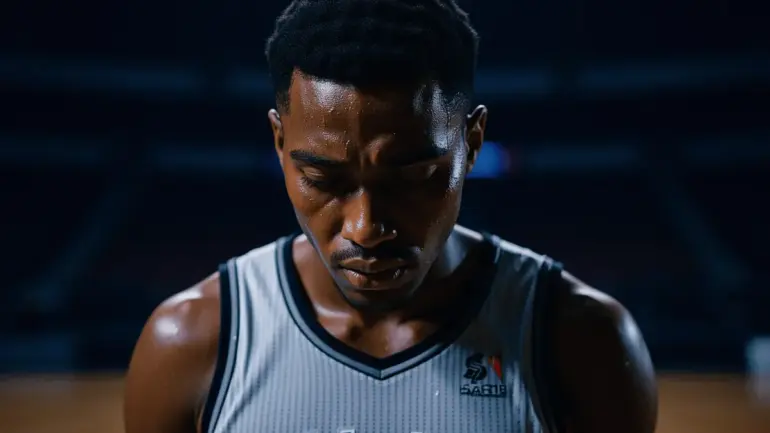
Victor Wembanyama addressed comparisons to Michael Jordan and LeBron James following the San Antonio Spurs’ 2026 NBA Finals loss to the New York Knicks in five games, calling the defeat ‘extremely painful’ while declaring it the biggest lesson of his life.
The San Antonio Spurs fell to the New York Knicks in five games – a result that stings harder given San Antonio blew a 29-point lead in Game 4 before a brutal fourth-quarter collapse sealed the series in Game 5. Wembanyama averaged 23.8 points, 10.9 rebounds, 3.5 blocks, and shot 60.6% true shooting across 22 postseason appearances.
What Wembanyama said in the aftermath reveals something more important than frustration. It reveals how a 22-year-old generational talent processes failure – and whether he frames it as an obstacle or a blueprint.
Victor Wembanyama Responds to the MJ and LeBron Comparison
Asked directly about Jordan and James – two players who each needed six seasons before claiming their first championship – Wembanyama did not deflect, and he did not perform humility.
Wembanyama said (Via Sportsnaut): “It’s extremely painful. But I’m not running away from that. I’m using that to fuel me. I’m sure all these guys you named, they’re not satisfied with being eliminated in earlier rounds or not making the playoffs, and I’m not satisfied with not winning. This is the biggest lesson of my life. As a team, there is no better experience.”
This is not deflection. This is a young player telling you exactly how he is wired. He is not contextualizing the loss as bad luck or blaming teammates. He is absorbing it as personal and organizational intelligence.
He also said – away from the cameras – that he and the Spurs “were not ready” and that he “wasn’t equipped to win a ring.” That is a harder admission than anything he said on the podium. It signals self-awareness that most players at his stage do not demonstrate publicly.
The MJ/LeBron comparison was not invented in a postgame press room. ESPN’s postseason tracking confirmed Wembanyama led the entire 2026 playoffs in Player Efficiency Rating (26.3), total rebounds, and total blocks – finishing second only to Jalen Brunson in total points. Those are GOAT-conversation numbers. While they do not guarantee GOAT status, they earn the right to the conversation.
Why the MJ and LeBron Comparison Carries Real Weight
Jordan lost in the first round six consecutive times before the Chicago Bulls broke through in 1991. LeBron got swept by the San Antonio Spurs in his first Finals appearance in 2007 – the same franchise Wembanyama now calls home. Both players used those early losses as calibration, not collapse.
Wembanyama now sits in identical historical company. He became one of just seven players in NBA history to average 23.8+ points, 10.9+ rebounds, 2.7+ assists, 1.0+ steals, and 3.5+ blocks on 60.6% true shooting across eight or more postseason appearances.
The list: Kareem Abdul-Jabbar (three times), Nikola Jokic (twice), Larry Bird, Charles Barkley, Karl Malone, and Hakeem Olajuwon. His Finals-year statistical line has only been matched by Kareem and Hakeem – both of whom own championship rings.
The comparison to MJ and LeBron is already earned at the statistical level. Whether it holds depends entirely on what Wembanyama does next – and the 2026 NBA Mock Draft context signals the league’s next wave is already arriving. Wembanyama needs to stay ahead of it.
The Complication – Fourth Quarters and Late-Game Execution
The numbers across 22 postseason games are dominant. The numbers in the fourth quarter of the Finals are not. Wembanyama shot 12-of-35 from the field in fourth quarters during the series. That is 34.3% shooting when the Knicks – a veteran, poised group – turned up the defensive pressure where it hurt most.
His turnover and foul on Jalen Brunson in the final minute of Game 2, and two missed free throws in the closing minutes of Game 4, were directly consequential. These were not bad-luck plays. They were execution failures in moments that Jordan and LeBron – in their championship runs – converted.
That gap matters. It is the precise gap that separates historically dominant postseason performers from champions. Barkley averaged elite playoff numbers and never closed it. Malone averaged elite playoff numbers and never closed it. The comparison to MJ and LeBron only holds if Wembanyama bridges that fourth-quarter distance. Right now, he has not.
The caveat here is age and exposure. Wembanyama is 22 playing in his first Finals. Late-game execution is a skill that develops under pressure – and no pressure is higher than an NBA Finals Game 4 with a lead evaporating. He now knows exactly what that feels like.
What Victor Wembanyama Does Next Changes Everything
The Spurs front office now faces a defined mission: surround Wembanyama with more reliable late-game creators before next season. The Finals exposed San Antonio’s depth limitations in ways that roster construction – not Wembanyama’s talent – can address. Watch the offseason free agency and trade activity as the clearest signal of organizational commitment to a quick return.
On the court, the variable to watch is fourth-quarter shooting efficiency in high-leverage playoff games. If Wembanyama converts from 34% to the 45-50% range in clutch situations next postseason, the MJ/LeBron comparison tightens considerably. If the pattern repeats, the conversation shifts toward the Barkley/Malone tier – generationally great, ring-less.
The GOAT debate always travels beyond basketball – the same way Messi’s 2026 World Cup positioning reframes his all-time legacy in real time. Wembanyama is in that conversation now, at 22, after a Finals loss that he called the biggest lesson of his life.
That is not a consolation framing. That is the correct framing. For the latest on Victor Wembanyama, the San Antonio Spurs, and the NBA offseason, keep it locked to Sportscasting.com.