
Chris Mannix, writing for Sports Illustrated after the Knicks’ Game 2 survival act in San Antonio, declared the NBA championship “there for the taking” for New York – and that language, from that specific voice, is not fan service. Mannix is a senior NBA writer at SI with a sourcing network that shapes how national media frames championship conversations, and when he anchors a Finals piece around inevitability language after a Knicks win, the futures market notices.
New York leads the NBA Finals 2–0 against the San Antonio Spurs. No team in Finals history has come back to win the title after losing the first two games at home. Those are the facts. Mannix is connecting them to a broader pattern – 13 consecutive wins, multiple players stepping up in every crisis moment, and a roster construction that suggests the Knicks are not just winning but winning sustainably.
Why This Mannix Take Carries More Weight Than Standard Punditry
Mannix operates at the intersection of sourcing and analysis in a way that separates him from pure opinion columnists. His NBA Finals coverage at Sports Illustrated, paired with his platform at NBC Sports, means his framing reaches the audience that moves betting sentiment – not just fans, but the national media ecosystem that shapes public perception and, by extension, futures pricing.
The specific construction he used matters. Mannix did not write that the Knicks could win or that the series is competitive. He wrote that the title is there for the taking – a phrase that signals organizational-level assessment, not individual enthusiasm. Mannix had previously argued during the regular season that a heliocentric Brunson offense might have a ceiling in a seven-game series, calling into question whether “nobody wins like that” over four playoff rounds. The fact that he is now deploying championship language is not a casual pivot. It reflects what he is watching on the floor.
His pre-Finals reporting also flagged Mitchell Robinson‘s health and De’Aaron Fox‘s ankle as the two biggest swing factors in the series. Both of those variables have resolved in New York’s favor through two games. That context makes his current framing more significant – this is not Mannix speculating about a team he covered loosely. This is Mannix updating a thesis he has been stress-testing for months.
The Basketball Logic – Why the Knicks Keep Finding a Way
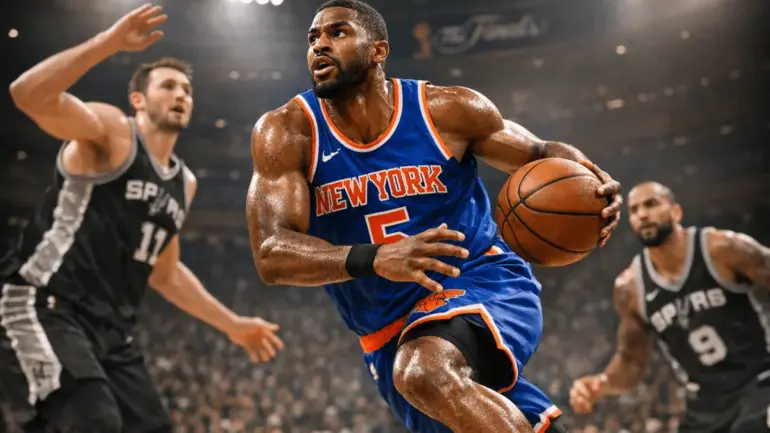
The Knicks’ case is built on complementary construction, not singular star power – and that distinction is exactly what Mannix is identifying. Jalen Brunson needed 25 shots to get his 20 points in Game 2 and went 2-of-8 from three. That is not an efficient performance. It didn’t matter.
Karl-Anthony Towns – who arrived via a blockbuster trade from Minnesota the previous summer and reshaped the Knicks’ ceiling overnight – finished Game 2 with 21 points and 13 rebounds, attacking the paint relentlessly and punishing every San Antonio small-ball adjustment. Mikal Bridges went 8-of-13 for 20 points. When Towns went to the bench in the third quarter with foul trouble and Brunson needed rest, Deuce McBride and Landry Shamet converted a four-point lead into nine. That is depth. That is the roster construction that makes the Knicks structurally different from teams that rely on two stars to carry every close game.
Brunson was averaging roughly 30 points and 7 assists per game entering the Finals. But the more telling number is the 13-game win streak that preceded Game 2 – a streak that included sweeps of Philadelphia and Cleveland and three straight wins over Atlanta. New York ranked top-3 in offensive rating and top-10 in defensive rating late in the regular season. That two-way identity is not a regular-season artifact. It is showing up in the Finals.
What This Means for NBA Title Odds Right Now
Before the Finals began, most major sportsbooks had the Knicks as slight series favorites in the –140 to –160 range, with San Antonio around +120 to +135. Those lines have already moved sharply after two road wins, and Mannix’s championship framing accelerates the perception pressure that drives further movement.
- New York Knicks: Expect continued compression on their title odds. The historical precedent – no team has ever come back from 0–2 at home in the Finals – is now the dominant line in every sportsbook’s public-facing narrative. Watch for the Knicks’ price to shorten further if they win Game 3 at Madison Square Garden.
- San Antonio Spurs: The Spurs’ title odds are effectively a long shot at this point. Victor Wembanyama’s missed game-winner and the Stephon Castle turnover sequence have become the story of the series – and that narrative pressure compounds on a young team heading into a hostile environment.
- Finals MVP market: Towns has been the most efficient star through two games. If he sustains his production at MSG, watch for his Finals MVP price to tighten relative to Brunson’s.
Odds referenced are for informational and entertainment purposes only. Lines shift continuously – confirm current prices with your sportsbook before acting.
For a full breakdown of how the series odds have moved since tip-off, the Game 1 odds and predictions piece provides the pre-series baseline that contextualizes how dramatically sentiment has shifted.
The Honest Pushback – Where the Championship Case Gets Complicated
Here is the honest pushback: the Knicks have not played well in either game they won. Brunson’s efficiency is a real concern – 25 shots for 20 points is a usage profile that will eventually catch up with a team in a close-out situation. The Spurs rallied from nine down to tie the game in the final minute of Game 2. That is not a fluke; that is a young, talented team finding its footing.
Wembanyama’s final shot rimmed out. Fox’s closing possession came up empty. But De’Aaron Fox was genuinely cooking in Game 2, and the Spurs’ first-quarter explosion – 18 points in the paint before the Knicks adjusted – shows San Antonio has the offensive tools to make New York uncomfortable at MSG. A desperate, young Spurs team with nothing to lose in front of a hostile crowd is a different animal than a team playing with house money.
What the pushback does not resolve: the historical record. No team has overcome an 0–2 deficit in Finals history. Mannix’s championship framing is grounded in that fact, and no amount of Spurs optimism changes the structural reality of what they now face.
What Happens Next – The Checkpoints That Convert Perception Into Reality
Watch for Brunson’s efficiency in Game 3. If he gets into a rhythm early at MSG and the shot count drops toward 18-20 attempts for similar production, the Knicks’ offensive ceiling rises substantially. The checkpoint worth tracking is his three-point percentage – he went 2-of-8 in Game 2, and sustained cold stretches from deep open up the defense for Wembanyama to protect the paint.
Watch for Towns in the fourth quarter. He went scoreless in the Game 2 fourth. If he and Bridges both go cold late in a close Game 3, the Knicks’ closing unit becomes Brunson-dependent in exactly the way Mannix once questioned.
Watch for Wembanyama’s offensive adjustments. The Spurs will not run the same final-possession play twice. How he and Mitch Johnson adapt in a hostile MSG environment is the single most important tactical variable remaining in the series.
Bottom Line
What is confirmed: the Knicks lead the NBA Finals 2–0, have won 13 consecutive games, and are returning to Madison Square Garden where no Finals opponent has ever engineered a comeback from 0–2 on the road. What is not confirmed: the title itself – two more wins against a Spurs team that has shown it can compete in close games and has the generational talent to make any possession dangerous.
Mannix deploying championship language is a signal worth tracking, not a verdict worth cashing. The single variable that determines whether his thesis becomes consensus reality: whether the Knicks can close at home with the same resilience they showed on the road – because that is the one thing this 13-game winning streak has not yet required them to prove.