

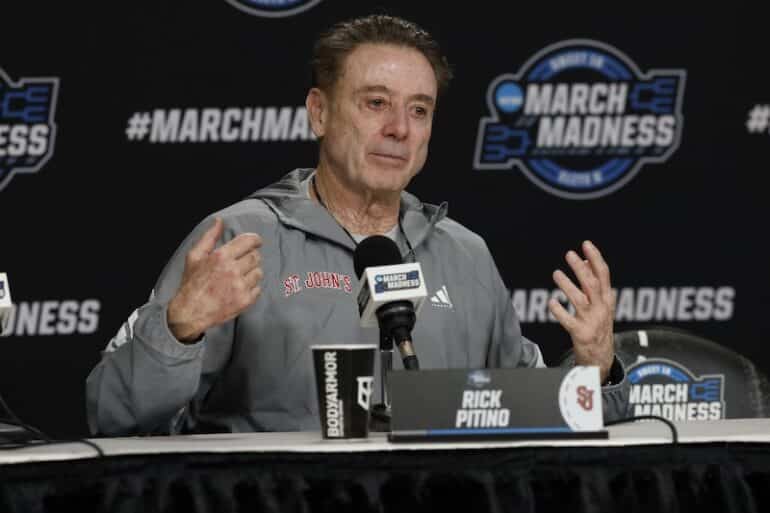
Rick Pitino has been in college basketball long enough to remember when the words “Kentucky” or “North Carolina” on a recruiting letter meant something. Coaches didn’t need a pitch, the brand was the closing argument. Those days, he says, are gone.
There’s No Difference Between NC State and North Carolina
“I don’t mean the blue bloods are dead,” Pitino told reporters Thursday ahead of St. John’s Sweet 16 matchup with Duke. “It’s just they don’t have the advantage that they once had because now everybody’s on the same level playing field.”
Then he said the quiet part out loud.
“There’s no difference between an NC State and a North Carolina.”
That single sentence would have been laughable fifteen years ago. Now it’s a reasonable read of a sport that has been fundamentally restructured by NIL and the transfer portal. The banners on the wall don’t close recruits anymore. The offer sheet does.
St. John’s head coach Rick Pitino says blue bloods no longer have a big advantage over others they once had.
“There’s no difference between an NC State and a North Carolina.”
(surely that quote will go over well where I live.) pic.twitter.com/hhQmzmFq4r
— Travon Miles (@TrayABC11) March 26, 2026
NIL Has Changed Recruiting
“You’re no longer going to Kentucky because of the facilities or the great history,” Pitino said. “You’re going there because you want to play for that coach, and obviously, your contract is very good.”
That word “contract” is the one that changes everything.
The moment a student athlete’s decision-making process started resembling a professional negotiation, the entire framework of blue-blood dominance collapsed.
Facilities were always a proxy for resources; now resources are just… money. Prestige doesn’t deposit into a bank account. Power Four conference teams now spend up to $20 million on rosters annually and Seth Greenberg recently revealed that teams need to spend around $12 million just to be competitive.
Pitino isn’t discouraged by the new era, he’s embracing it.
“It’s free agency and we all know the reasons why,” he said. “Money has come into play. So, what’s the difference between the Knicks and the 76ers? Well, it depends on where you’re from.”
The NBA analogy is more than colorful.
The league Pitino is comparing college basketball to has no recruiting advantages built in. Every team competes for the same players with roughly the same tools. A player signs where the fit is right, the coach is compelling, and the money makes sense. Geography and loyalty and legacy all factor in, but none of them trump the deal. That’s college basketball now.
“It’s the same as pro ball,” Pitino said. “There’s no difference.”
The Coaching Carousel Turns Faster
What this means practically is a fundamental reshuffling of power — not just in recruiting, but in the coaching carousel itself.
If players are choosing coaches over programs, then coaches become the entire value proposition. A great coach at a mid-level program is now a genuine threat to outrecruit a mediocre coach at a blue blood.
That was never really true before. It is now. Which means the pressure on elite programs to retain elite coaches has never been higher — and the price tags reflect it.
It also means the carousel spins faster and more chaotically than ever.
Coaches who can work the portal, build relationships quickly, and sell a vision without leaning on institutional prestige are the ones surviving. Those who relied on the program selling itself are getting lapped. The half-life of a roster is a year, sometimes less. Building through relationships with 17-year-olds over three years of in-home visits has been replaced by building through relationships with 21-year-olds over three weeks in the portal window.
Pitino Has Adapted Better Than Most Coaches
Pitino, at 73, has adapted to all of it better than most coaches half his age. That’s not accidental. He spent time coaching professionally in Europe, where one-year contracts and roster turnover were simply the operating reality. He came back to college basketball with a pro coach’s mindset grafted onto a college structure — and it fits the current moment perfectly.
The uncomfortable truth his comments expose is that programs still selling themselves on history are operating with an outdated pitch deck.
The kids they’re recruiting didn’t watch the 1982 national championship. They watch NIL deal announcements. When Pitino says there’s no difference between an NC State and a North Carolina, he’s not diminishing Carolina’s legacy.
He’s saying the kid in the portal doesn’t care about the legacy. He cares about the coach in front of him and the number on the offer.
College basketball didn’t become the NBA overnight. But it’s close enough now that one of its most decorated coaches is drawing a straight line between the two and daring anyone to argue with him.