
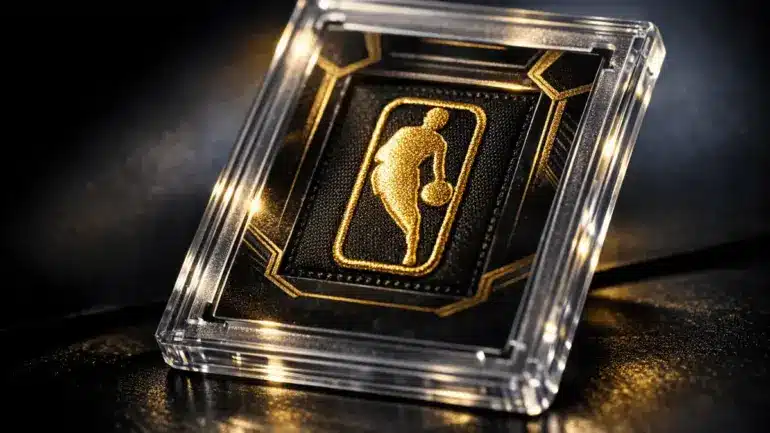
A 1-of-1 gold Logoman Autograph redemption card featuring Shai Gilgeous-Alexander sold for $1,061,400 at Goldin Auctions on Saturday – a record for this category of collectible and a number that demands more than a passing glance. The card, which drew 42 bids and cleared a $870,000 hammer price before buyer’s premium, will be exchanged for a 2025-26 Topps Chrome Gold Logoman Autographed Relics piece featuring SGA’s on-card signature and a game-worn gold Logoman patch, the kind worn exclusively by major award winners during the season. That price tag is not just a collector’s milestone. It is a market verdict on where Gilgeous-Alexander stands among the NBA’s most commercially powerful names – and the verdict is unambiguous.
The Logoman Sale – What a $1 Million Card Actually Signals
The gold NBA Logoman patch is the hobby’s version of a certified relic from the throne. Topps and Fanatics, after acquiring the league’s trading-card rights, positioned the Gold Logoman Autographed Relics subset as the apex chase of the revived Topps Chrome Basketball line – a handful of true 1/1s reserved for the sport’s most bankable names. The SGA card sits alongside peers like Victor Wembanyama and Stephen Curry in that checklist, which hobby media described as “one of the craziest chase lineups we’ve ever seen” for a basketball release.
The $1,061,400 result does not exist in a vacuum. A 2023-24 Panini Flawless 1-of-1 Logoman Autograph of Gilgeous-Alexander sold for approximately $577,300 at Goldin in early 2025 – itself a then-record for any SGA card. Saturday’s result nearly doubled that number in roughly one year. That trajectory is not a soft data point. It is a directional signal with serious velocity.
For additional context on what this price tier means cross-sport: a Shohei Ohtani MLB Gold Logoman 1/1 was projected by hobby media to exceed $1.26 million at auction, placing the SGA result in the same commercial conversation as the most recognizable athlete name in baseball – a player whose historic marketability and on-field dominance have redefined what an athlete brand can look like.
SGA’s Star Power Breakdown – Why His Marketability Has Reached This Level
Start with the on-court case, because it is overwhelming. Gilgeous-Alexander averaged 31.1 points on 55.3 percent shooting, with 6.6 assists and 4.3 rebounds per game last season – numbers that would make him a consensus MVP candidate in virtually any era. He is a back-to-back MVP at 27 years old, a four-time All-Star, and a four-time All-NBA selection. The Oklahoma City Thunder led the league in regular season wins for the second consecutive year, posting 64 wins in 2025-26. The performance foundation beneath the brand is not fragile.
The more interesting layer is how SGA has built commercial gravity despite playing in a mid-sized market. Oklahoma City does not carry the media infrastructure of Los Angeles or New York, yet the card market – which operates on perceived trajectory, not market size – has priced him at the very top of the sport. That is a meaningful distinction. The analogy worth drawing is Stephen Curry, who turned a small-market dynasty in Golden State into one of the most valuable personal brands in sports, eventually culminating in a landmark business arrangement – the kind of 10-year partnership with Li-Ning that reshaped what athlete sub-brands can look like outside of Nike’s orbit. SGA’s arc is drawing similar structural comparisons from brand analysts and hobby investors alike.
The Goldin listing also noted that the redemption does not expire until December 31, 2035 – a detail that functionally de-risks the purchase and signals that buyers are treating this as a long-horizon asset, not a speculative flip. Institutional confidence looks different from collector enthusiasm. This reads like the former.
The Memorabilia Market as a Barometer – What Card Prices Actually Tell Us
The collectibles market does not react to what an athlete has already done. It prices what collectors believe an athlete will become. That makes high-end memorabilia sales a leading indicator of perceived trajectory – closer to a futures contract than a historical certificate. When SGA’s Logoman crosses $1 million at 27, the market is not commemorating his past. It is betting on the next decade.
The comp set reinforces this reading. Athletes whose 1/1 Logomans trade at this level – LeBron James, Nikola Jokić, Curry – share a common characteristic: the market views their peak as either ongoing or recently concluded, with legacy already secured. Hobby analysts have framed SGA’s result as confirmation that his market has “made the leap from star to Tier 1 hobby icon.” That framing matters because it describes a ratchet, not a pendulum – players who reach this tier rarely fall back out of it without a catastrophic injury or a sustained performance collapse.
The Honest Pushback – What Could Still Complicate SGA’s Ascent
Here is the honest accounting: the Thunder’s Western Conference Finals exit against the San Antonio Spurs in seven games is a complicating data point that cannot be dismissed. OKC won 64 regular season games and lost to a team that will now carry its own ascending star narrative. Back-to-back MVPs who exit in the conference finals – without a championship – eventually face a market recalibration if the pattern holds.
The small-market ceiling is real, even if Curry partially disproved it. SGA’s cultural footprint outside of basketball circles remains narrower than his on-court standing would suggest it should be. A player averaging 31 points with back-to-back MVPs should be omnipresent in mainstream media. He is not yet, and that gap between performance and cultural penetration is the primary variable the memorabilia market has already priced in as resolvable – but has not yet confirmed.
There is also the straightforward risk of injury. SGA has been durable, but 27 is not a guarantee, and a 1-of-1 card tied to a single athlete’s trajectory carries concentrated exposure. The $1 million buyer is betting on a decade of continued ascent. That is a long time in professional sports.
Bottom Line
A $1 million Logoman sale does not happen for a player the market views as merely excellent. It happens for players the market believes are building toward something lasting – a championship legacy, a crossover cultural footprint, a brand that outlives the playing career. At 27, with back-to-back MVPs and the league’s best team by regular season record, Shai Gilgeous-Alexander has given the market every structural reason to believe that combination is coming.
The next observable benchmark is a championship. A title in Oklahoma City would remove the last credible ceiling on his brand valuation and likely make Saturday’s $1,061,400 look like a discount. Watch for what SGA’s next major memorabilia piece trades at after the 2026-27 season – that number will tell you whether the market held its conviction or quietly revised it.