

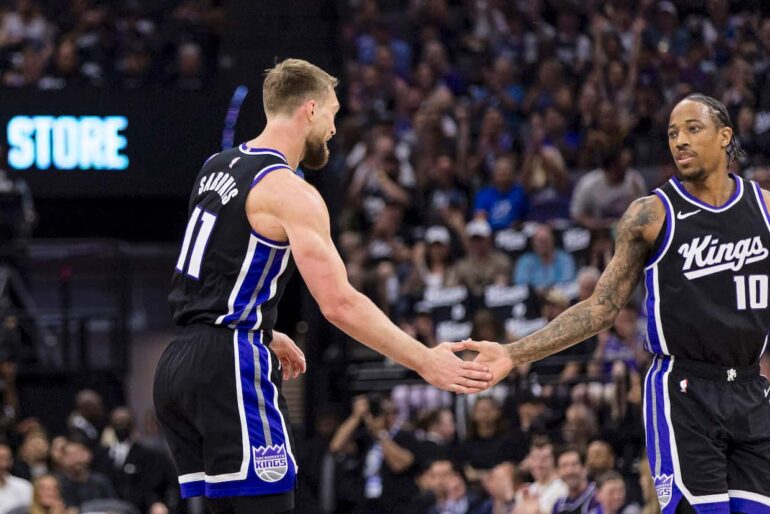
I’ll be the first to admit I thought the 2024-25 Sacramento Kings could be a dark horse contender in the Western Conference. I even had some hope their midseason acquisitions would help reinvigorate their season.
Maybe, it was their aesthetically pleasing uniforms. Maybe, it was the fond memories of their feel-good 2022-23 campaign. Maybe, it was the chill-provoking sensation of hearing the roar of Golden 1 Center after watching their team go on a coffin-closing fourth-quarter run.
Whatever it was, I tended to give the Kings the benefit of the doubt. I wanted to believe no professional basketball team made decisions without deep consideration to their pros and cons. But man, was I wrong and the current iteration of this team is the perfect example why.
However, even though the 2025-26 Kings make absolutely no sense, they may be too interesting for you to keep your eyes off of them.
An Imbalanced Roster
When a veteran team fails to meet expectations, its decision-makers generally have two options. They can tear it all down and go for a full-scale rebuild or they can use their assets to retool the roster and address the shortcomings that previously held the roster back.
It feels like the Kings went down the latter path. Yet based on what they did, one must wonder if the front office had an adequate grasp of what this team needs. I speak a lot about lineup balance on this website. For the Kings to achieve this ideal, they needed to replace some of their on-ball scoring with playmaking, size and spacing.
As it stands, the Kings still employ Domantas Sabonis, DeMar DeRozan, Zach LaVine and Malik Monk — the core four that failed to mesh during the second half of last season. Their marquee offseason move was executing a sign-and-trade with the Detroit Pistons to add Dennis Schroder.
Schroder addresses the Kings’ need for more ball-handling — although, I would argue his aptitude in this area is a bit overstated — and his point-of-attack prowess will certainly boost a unit that finished 23rd in defensive rating last season. But the 6-foot-1 guard does little to address their size and spacing (career 34.2 percent 3-point shooter) issues.
On top of that, Schroder adds another body to a flooded backcourt. Along with Monk, Schroder and LaVine, the Kings also have Keon Ellis and Devin Carter, whom they need to find minutes for as two of their best two-way players.
I’m obsessed with their decision to trade into the first round of the 2025 Draft and land Nique Clifford. He’s a great shooter (37.7 percent from three his last two years of college) with good defensive indicators. Yet at 6 feet 5 inches with a 6-foot-8 wingspan, Clifford functions more like a two or three at the NBA level — positions at which Sacramento already seems loaded.
Their only real front-court additions were Drew Eubanks and Dario Saric. Funny enough, those two tied for their standing in 2024-25 Estimated Plus-Minus (EPM). Not so funny is it happened to be in the 10th percentile (468th and 471st overall, respectively). To make matters worse, they traded away one of the league’s better backup bigs, Jonas Valanciunas, for Saric to make room for Schroder, a guard further crowding their backcourt.
Now, the Kings could still make a trade or two. We’ve heard rumors about them shopping the likes of Monk and DeRozan. But in their current state, they feel like an even more confusing version of the flawed team they were last year. That does not portend well in a Western Conference which has only grown stronger this summer.
Why You Won’t Be Able To Keep Your Eyes Off Them
As a general rule, it’s hardly ever the über-talented teams responsible for innovation. After all, why would they need to go against the status quo when they’re already the best at the current paradigm?
Normally, change begins with a middling team trying desperately to punch above its weight class. For instance, while an elite defensive team, the Houston Rockets had one of the worst offensive infrastructures among competitive teams last year. To counterbalance this, they often employed a double-big lineup to help juice their offensive rebounding and give them more bites at the apple. This season, expect more teams to use these sorts of jumbo lineups as they try to jump on the NBA’s newest fad.
With the league generally prioritizing size on the floor, the Kings could try to zig while everyone else zags. Size is clearly not a strong suit for them, but what they do have is speed. While everyone else is playing two centers together, the Kings will be fielding micro-ball lineups featuring three guards, a stretch four and Sabonis, who is generally considered an undersized five.
Envision a lineup of Schroder/Monk/LaVine/Murray/Sabonis, or, maybe, one with Schroder/Ellis/Monk/Clifford/Sabonis. Add in Carter and DeRozan as well. This version of the Kings can push the ball down people’s throats and field myriad exotic defenses intended to turn teams over and catalyze their offense.
Last season, over 151 possessions, the Kings posted a plus-12.5 net rating with the lineup of De’Aaron Fox/Ellis/Monk/DeRozan/Sabonis (per Cleaning the Glass). In 73 possessions with Ellis/LaVine/Monk/Murray/Sabonis on the floor, their net rating was plus-26.1. Now, imagine a whole season of these three-guard lineups.
Maybe, Sacramento will push the game back toward small-ball units prioritizing skill over size. Or, maybe, it’ll crash and burn, and continue its two-decade run as an NBA laughingstock. In any event, this mismatch cast will be worth keep an eye on, even if it isn’t abundantly clear what we are watching.