
As the 2025-26 NBA season quickly approaches, the Sportscasting crew has teamed up to posit one important question for every team this year. Up next is the Northwest Division.
Let’s get to it.
Read our other Division previews: Atlantic / Central / Southeast / Pacific
Denver Nuggets: Can The Offseason Additions Provide Enough To Push Them Over The Top?
Over the last few offseasons, the Denver Nuggets largely sat on their hands, neglecting to meaningfully upgrade a roster that won a title in 2023. Their new front office, however, provided more activity this summer, trading for and signing a slew of veteran contributors — Cameron Johnson, Tim Hardaway Jr., Bruce Brown and Jonas Valanciunas.
Across the last three seasons, Denver’s core four (Nikola Jokic, Jamal Murray, Aaron Gordon and Christian Braun) bludgeoned regular-season and playoff opponents. That quartet outscored opponents in 2025 (regular and postseason) by a ludicrous 12.7 points per 100 possessions.
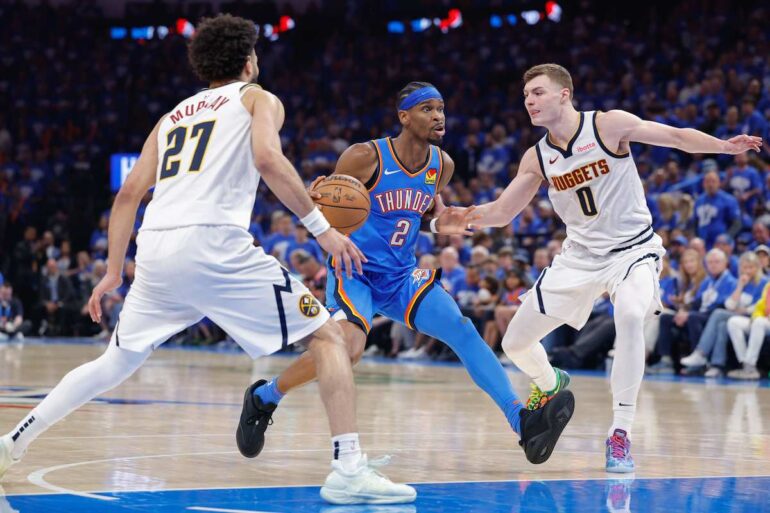
The Nuggets pushed the title-winning Oklahoma City Thunder to seven games, despite only having four reliable playoff contributors.
Oklahoma City and the Los Angeles Clippers both schemed around the weaknesses of Denver’s fifth player, whether those be Peyton Watson’s weak offense or Russell Westbrook’s chaos and inconsistency. Playoff defenses should have a tougher time leaving Hardaway alone and we’ve seen the damage Brown can cause as a pseudo-big while paired with Jokic.
Swapping Michael Porter Jr. for Johnson is a straight upgrade; Johnson provides the same elite floor-spacing with better ancillary skills. He’s a well-rounded offensive player at this stage in his career with the secondary playmaking and slashing chops to spell Murray and Jokic at times.
Denver hasn’t fielded a competent backup big during Jokic’s tenure but it may have two this season. Valanciunas isn’t a world beater but his size and interior scoring give the Nuggets far more than players like DeAndre Jordan, Zeke Nnaji or Dario Saric ever could. They’ll hope rookie DaRon Holmes II, who tore his Achilles last summer, can add even more offensive versatility in the front-court.
The greatness of Jokic provides the post-title Nuggets with an unshakeable floor. To reach title-winning heights again, they’ll need more optionality than they’ve previously had. Whether their offseason additions make that a reality, they’ve set themselves up well to make a serious push for another championship. -Ben Pfeifer
Minnesota Timberwolves: Are The Young Guys Ready To Contribute?
Fresh off consecutive Western Conference Finals appearance, both of which saw historic seasons for the franchise flame out in 4-1 exits, the Minnesota Timberwolves enter 2025-26 looking to take that challenging, crucial step into the utmost echelon of championship contention.
Of course, Minnesota reached those conference finals with varied roster compositions, initially flanking Anthony Edwards with the sweet-shooting Karl-Anthony Towns before swapping him for the bruising Julius Randle last fall. Yet as they aim to continue progressing, they’ll likely need new faces to emerge. Gone is three-and-D ace Nickeil Alexander-Walker to the Atlanta Hawks while veteran stalwart Mike Conley Jr. turns 38 in a week and has exhibited considerable decline the past year or so.
Both have proven instrumental in Minnesota’s recent success but, for different reasons, cannot be counted on to replicate that moving forward. In their stead, the Wolves will hope youthful options such as Terrance Shannon Jr. and Rob Dillingham can cement themselves as viable alternatives — and, maybe, even upgrades.
Among Minnesota’s foremost issues the last two seasons has been a lack of offensive pop beyond Edwards and his running mate (Towns, then Randle). If they develop as preferred, both Shannon and Dillingham project to help alleviate some of those concerns. Shannon is a rugged, fearless slasher touting off-ball savvy and playmaking gusto; whether it’s as a cutter or attacking closeouts, he can punish seams in the defense. Dillingham is a jittery pick-and-roll creator with the skill-set to get downhill, facilitate and drill jumpers on or off the ball — in an ideal world.
Those are all skills the Wolves would greatly benefit from featuring offensively around Edwards and Randle. None of this is to discount Jaylen Clark, who flashed promise as a rookie last year, but looks more like a perimeter pest who knocks down open triples than someone really boosting the offense like Shannon and/or Dillingham could.
Minnesota’s rotation is largely filled with known variables. Edwards, Randle, Rudy Gobert, Jaden McDaniels, Donte DiVincenzo and Naz Reid form a tremendous top six that should jostle for home-court advantage in the West. But they alone are not enough to expand upon the accomplishments of the last two seasons. It’s Wolves’ youngsters who could elevate this group beyond merely a top-four seed into something loftier and rosier than how the past two years have concluded. -Jackson Frank
Oklahoma City Thunder: Can They Diversify Their Offense?
Last season, the Oklahoma City Thunder went 68-14 and posted the second-best net rating in NBA history at plus-12.7. Then, of course, they won the NBA Finals. To begin this season, the average age of their three best players is just under 25 years old. They did not lose any valuable rotation pieces over the summer.
And yet, it feels like they have room to improve! En route to the title, Oklahoma City was taken to seven games twice, first by the Denver Nuggets in the second round then by the Indiana Pacers in the Finals.
In both series, it felt like the Thunder’s monotonous half-court offense kept their less talented opponents alive. The Nuggets were not the better team but they were more unpredictable. Where was Nikola Jokić going to get the ball? How would he get it? Who would be in the action with him? As for the Pacers, well, their tendency to whip the ball around the court and cycle through actions after action is well-documented.
But if they couldn’t force a turnover and run in transition (to be fair, they often could), the Thunder resorted to Shai Gilegous-Alexander or Jalen Williams running high pick-and-roll or an isolation at the top of the key with little going on around it. Now, those two are All-NBA players, so that’s not easy stuff to stop. But it’s easy to game-plan against.
In Game 1 of the Finals, Oklahoma City took 33 midrange jumpers and 30 3-pointers. It shot a poor 55.6 percent at the rim — a tad unlucky, sure, but Indiana always knew how and where to send help, even with head coach Mark Daigneault starting Cason Wallace over Isaiah Hartenstein. Gilgeous-Alexander and Williams can make any midrange shot but that is shot quality unbecoming of such a dominant team on the biggest stage.
So, my question for OKC: Can it diversify its approach this season? Can the Thunder lean on the multi-talented Chet Holmgren — whose pelvic fracture completely disrupted the rhythm of his 2024-25 campaign – to make their offense a little funkier? Some more inverted ball-handling here, some more cutting here, some more pick-and-pop here, who knows?
If they can, the Oklahoma City Thunder might just become untouchable this season. -Lucas Kaplan
Portland Trail Blazers: How Good Can An Offense Be With No Great Shooters?
I think the Portland Trail Blazers’ defense is going to be sick. In fact, depending on how dialed in the Oklahoma City Thunder are during the regular season, I think the Blazers have a legit chance of being the NBA’s top-ranked defense.
Their defense alone should be enough to make them respectable. But if the Blazers want to be a playoff team in 2025-26, they do need to score some points.
Half-court offense is largely tied to two variables: shot creation and spacing. With Deni Avdija, Scoot Henderson and Shaedon Sharpe, Portland has a solid cast of players who can generate their own offense. But do they have the shooters to make teams pay for the advantages that trio unlocks?
To acquire Jrue Holiday – one of the best perimeter defenders of the 21st century – Portland traded away its best shooter in Anfernee Simons (career 38.1 percent 3-point shooter). Now, the best shooters in the Blazers’ main rotation are Jerami Grant (36.4 percent), Holiday (37 percent) and Sharpe (33.1 percent). None of those players are what I would consider great shooters.
Last season, the Houston Rockets faced a similar dilemma, which led to them being the 22nd-ranked half-court offense (per Cleaning the Glass). However, they were still able to place 12th in overall offense thanks to their offensive rebounding (first in put-backs) and transition scoring (eighth in transition).
The Blazers placed second and 29th in those categories, respectively. So, they have the ability to generate second-chance looks but struggled playing with pace. Can head coach Chauncey Billups speed up their offense enough to get more easy looks early in the shot clock? The answer to that question may determine whether the Blazers are playing competitive basketball this spring. -Mat Issa
Utah Jazz: They Aren’t Actually Done Tanking, Right?
After the Utah Jazz hired him this summer as President of Basketball Operations, Austin Ainge made it clear tanking isn’t an option for him. Even if Utah won’t intentionally try losing games to secure a top pick in a loaded 2026 Draft, it has the lowest projected win total (18.5) of any team and a roster that resembles a rebuild.
Utah’s roster features seven first-round picks (and 2024 32nd pick Kyle Filipowski), none of whom have yet developed into solidly positive NBA players. Will Hardy, who will enter his fourth year coaching the Jazz, is still searching for a winning season. Regardless of their eventual win total, one or multiple of their young players must develop into franchise cornerstones.
There’s plenty of potential in Utah’s young core to nurture if rotations and hierarchies allow. Isaiah Collier was one of the NBA’s most productive passers as a rookie. Brice Sensabaugh is already an elite shot-maker and Filipowski was an effective offensive rookie. The Jazz’s 2025 draft picks, Ace Bailey and Walter Clayton Jr., both add more shot-making and floor-spacing firepower.
Most of their veterans — Lauri Markkanen, Walker Kessler, Kyle Anderson — occupy the front-court, which theoretically could provide a reasonable floor if the Jazz find better injury fortunes. But in a stacked Western Conference, even a Play-In Tournament appearance would be a miraculous outcome.
Will player development be enough to satisfy Ainge and the front office? The Jazz haven’t made the playoffs since trading away Rudy Gobert and Donovan Mitchell after the 2021-22 season, even with an excellent head coach. We’ll see how Utah responds to a likely underwhelming season but success for the Jazz only necessitates the emergence of true building blocks. -Ben Pfeifer