
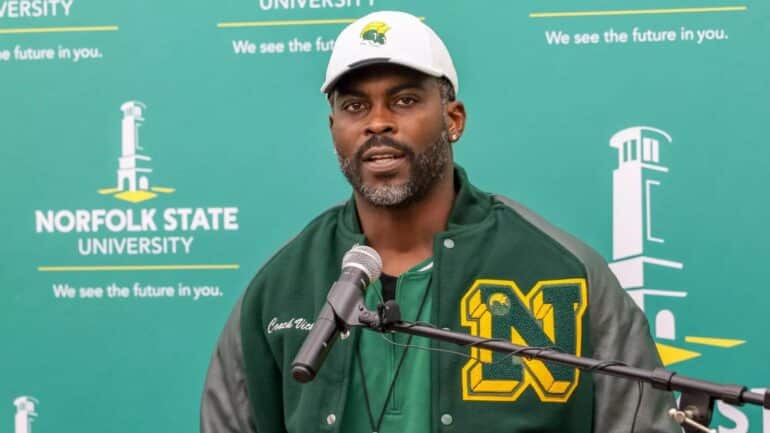
Former NFL stars Michael Vick and DeSean Jackson have taken head-coaching roles at HBCUs, bringing celebrity, recruiting power, and media attention to programs like Norfolk State University and Delaware State University. Their hires reflect a growing strategy in college football.
One Friday morning in October, Michael Vick stood on the sideline at Norfolk State with a renewed purpose. Across town at Delaware State, DeSean Jackson prepared to lead his first HBCU squad onto the field in Philadelphia.
Michael Vick and DeSean Jackson will coach against each other at Lincoln Financial Field on Thursday night 🔥 https://t.co/tSxap5QWQe pic.twitter.com/BYE5Stdsab
— Eagles Fan Central (@PhilaFanCentral) October 29, 2025
The former NFL teammates-turned-head coaches are rewriting the script for Historically Black Colleges and Universities football. With limited coaching experience between them, Vick and Jackson are nevertheless rapidly becoming symbols of a trend where big-name athletes are tapped to boost program visibility, recruitment, and revenue.
In a landscape still adjusting to changes in athlete compensation and media shifts, their journeys carry weight both on and off the field.
Celebrity coaching as a tool, not a silver bullet
When Norfolk State hired Vick and Delaware State brought in Jackson, each institution knew it was making a bold investment.
For Vick, a local product and former national star, the job offered a chance to reshape a football program that has struggled for relevance. The Spartans are presently 1-7 this season, but ticket sales, media coverage, and recruitment interest have already surged under his leadership.
After a 1-6 start, Michael Vick confirms that multiple defensive coaches are no longer with the Norfolk State staff
“I expect a certain standard. I’m gonna always live by that” @HbcuPass @WAVY_News pic.twitter.com/ENIm4BFKYc
— James Kattato (@jckattato) October 21, 2025
Jackson’s impact has been more immediately measurable. Delaware State, which was 1-11 last year, is 5-3 this season under his direction.
Applications to the school have jumped, and a high-profile home game has been secured at Philadelphia’s Lincoln Financial Field.
But as athletic directors caution, the celebrity coach strategy is not a guarantee of wins. Schools must still address facility upgrades, staffing support, and recruiting fundamentals. Vick himself recently admitted his squad’s on-field performance remains a work in progress.
Bigger implications for HBCUs and college football
The Vick-Jackson era at HBCUs is more than a novelty; it is emblematic of how smaller programs are strategizing in the modern college football world. With shifting revenue landscapes, name-image-likeness rules, and corporate sponsorships all in flux, visibility matters.
A former NFL star can unlock ticket sales, media partnerships, and national branding faster than tradition alone.
DeSean Jackson talks about going up against his former teammate Michael Vick 👏 pic.twitter.com/lhpCRtKiVh
— First Take (@FirstTake) October 29, 2025
These hires reflect a convergence: NFL fame becomes a college football commodity, HBCUs become premium platforms, and coaching becomes a vehicle for recruitment and business as much as wins.
As DeSean Jackson put it, the moment represents an opportunity to “have a big influence” and build more than a season; he aims to build a legacy.
Setting the trend in college football
Michael Vick and DeSean Jackson may have entered coaching through familiar NFL-alumni channels, but their new roles at Norfolk State and Delaware State are anything but routine. They are among the leaders of a reshaping era in HBCU football, an era that prizes visibility, branding, and cultural relevance as much as victories.
The stakes extend beyond final scores. At these programs, recruiting, community engagement, and media traction matter.
The success of Vick and Jackson as coaches will thus be judged not only by wins and losses but by how well they fuse star power with substance. For HBCU football and college athletics at large, this moment could mark the most significant narrative shift of the decade.