

Adding two teams sounds simple. It isn’t.
At a reported $7-10 billion per franchise, the NBA’s expansion into Seattle and Las Vegas would be the most expensive team purchases in sports history. But the money is the easy part.
When both cities tip off in 2028-29, the league faces a structural problem it hasn’t had to solve in decades. Thirty-two teams don’t fit the current six-division framework. Something has to give.
The Core Problem
Both new franchises land in the West, leaving 15 Eastern and 17 Western teams.
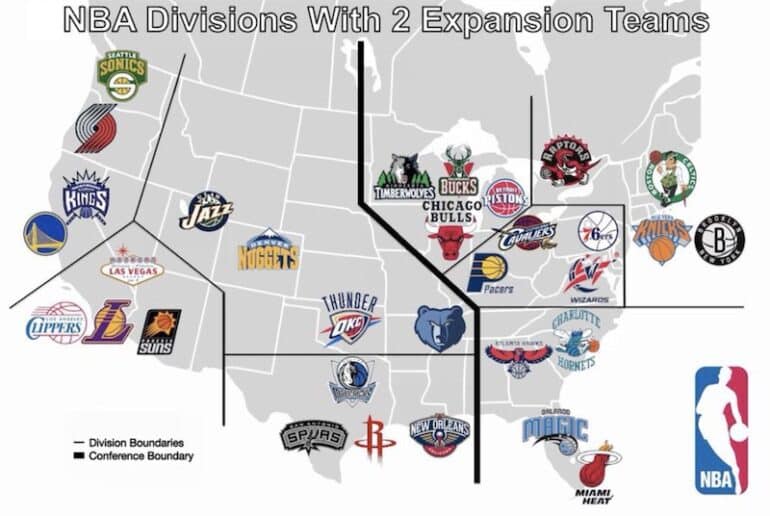
One Western team has to move East. And six divisions of five doesn’t divide into 32, so the cleanest fix is four divisions of eight. This would require a real overhaul, one that is long overdue.
The league could also keep six uneven divisions or eliminate divisions entirely and organize scheduling strictly by conference. Neither of these present as clean of a restructuring as a move to four divisions of eight teams.
Who Moves East: Memphis or Minnesota?
This is the central debate.
The instinctive answer is Memphis. Tennessee is geographically Eastern, and the Grizzlies have more in common logistically with Atlanta or Charlotte than with Phoenix or Denver.
But the stronger case is Minnesota.
The Timberwolves’ closest Western Conference neighbor is Denver, 680 miles away. Six Eastern cities — Milwaukee, Chicago, Indianapolis, Detroit, Cleveland, and Toronto — all fall within that same radius.
Minnesota is geographically marooned in the West in a way Memphis simply isn’t. Moving Anthony Edwards to the East also improves competitive balance, which the league badly needs.
Most analysts land here: Minnesota moves.
Proposed Conference Realignment
EASTERN CONFERENCE
Atlantic Division
- Boston Celtics
- New York Knicks
- Brooklyn Nets
- Philadelphia 76ers
- Toronto Raptors
- Washington Wizards
- Cleveland Cavaliers
- Detroit Pistons
The Northeast corridor plus the rust belt cities. This alignment is geographically tight, and historically rich.
Southeast Division
- Miami Heat
- Orlando Magic
- Charlotte Hornets
- Atlanta Hawks
- Indiana Pacers
- Chicago Bulls
- Milwaukee Bucks
- Minnesota Timberwolves
Gulf Coast through the Great Lakes, with Minnesota sliding in as the northern anchor. Chicago and Milwaukee stay paired. Indiana and Cleveland-area markets remain on the same side of the equation.
WESTERN CONFERENCE
Pacific Division
- LA Lakers
- LA Clippers
- Golden State Warriors
- Sacramento Kings
- Phoenix Suns
- Portland Trail Blazers
- Seattle
- Las Vegas
The two expansion teams anchor this division. Seattle and Portland, 175 miles apart, develop an immediate natural rivalry. Las Vegas slots in as the desert anchor. The California franchises provide the marquee matchups both new franchises will need early.
Central Division
- Oklahoma City Thunder
- Denver Nuggets
- Utah Jazz
- Dallas Mavericks
- Houston Rockets
- San Antonio Spurs
- New Orleans Pelicans
- Memphis Grizzlies
The Texas-Oklahoma-Colorado core stays intact. Memphis lands here if Minnesota moves East, keeping San Antonio, Houston, New Orleans, Memphis paired together.
What This Does to Rivalries
Created: Seattle vs. Portland is an instant rivalry. Las Vegas vs. Phoenix compete for the same Southwest fan base. OKC vs. Seattle carries two decades of unresolved tension from the Sonics relocation. Adam Silver won’t need to manufacture that storyline.
Lost: The current Pacific Division loses some of its rivalry intensity at eight teams. Division opponents currently meet four times a season; a larger division likely reduces that frequency, meaning Lakers-Warriors or Warriors-Portland carries less regular-season weight over time.
NBA Playoffs: Unchanged
Expanding to 32 teams doesn’t change the postseason structure. Eight teams per conference still qualify — six direct playoff berths, and four play-in teams battle it out for the final two spots. The current format holds.
Seattle and Las Vegas aren’t just filling empty chairs. They’re forcing Adam Silver to rethink how the whole league is arranged.