
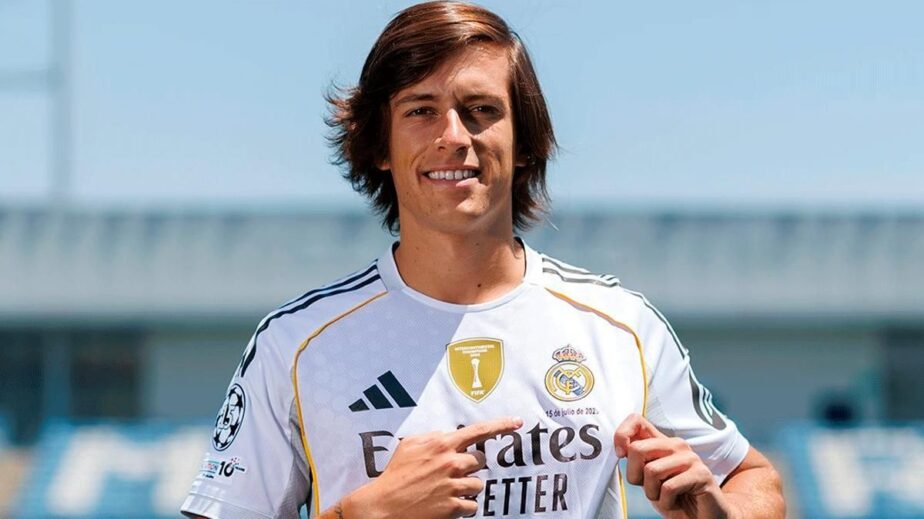
Alvaro Carreras has become the latest player to leave Real Madrid, only to return for a higher fee.
The Spanish left-back has joined the All-Whites for a £43 million fee, rejecting advances from Manchester United.
Carreras’ return extends a curious trend at Real Madrid, of bringing back players who were once allowed to depart. SportsCasting investigates how and why they achieve this, the pros, and, of course, the cons.
Alvaro Carreras Joins Real Madrid From Benfica
On Tuesday, July 15, Real Madrid officially announced the signing of Alvaro Carreras from Portuguese side Benfica. They have signed the 22-year-old for a £43 million fee, tying him down to a six-year contract. They wanted to sign him before the Club World Cup, but failed to close the deal in time.
Joining from Manchester United last summer, Carreras enjoyed a breakout campaign for Benfica in 2024/25. He played 52 games for the club in all competitions, including 10 in the UEFA Champions League, scoring 4 goals and providing 5 assists.
🤩 #WelcomeCarreras 🤩 pic.twitter.com/uUcJO1nwsg
— Real Madrid C.F. (@realmadrid) July 14, 2025
Capable of playing both at the heart of the back-line and down the left, Carreras adds a new dimension to Los Blancos’ defence. He is Madrid’s third defensive addition of the summer after Dean Huijsen and Trent Alexander-Arnold.
Why Alvaro Carreras Left Madrid
Alvaro Carreras has joined Real Madrid as one of the most promising left-backs in the world. However, he will have no illusions about the difficulty of the job at hand.
Carreras joined Real Madrid Youth from Deportivo Youth in 2017. After a couple of years, he got promoted to Real Madrid U17. Carreras could not make a name for himself in the packed Real Madrid academy. In 2020, he left the Santiago Bernabeu as a free agent, joining Man Utd’s U23 side.
Álvaro Carreras is back at Real Madrid ⚪ pic.twitter.com/mPenMEk0XY
— B/R Football (@brfootball) July 15, 2025
Until July 2024, he was on Man Utd’s payroll, but he did not play a single game for the senior side. Following loan spells at Preston and Granada, Carreras finally ended up at Benfica, where he finally got the break of his career.
Why Have Real Madrid Brought Alvaro Carreras Back
Real Madrid ended the 2024/25 season without winning even a single major honour. They lost the LaLiga title, the Copa del Rey, and the Supercopa de Espana to Barcelona. Crashed out of the UEFA Champions League after suffering a 5-1 aggregate defeat to Arsenal. And lastly, fell to an embarrassing 4-0 defeat against Paris Saint-Germain in the FIFA Club World Cup semi-finals. It was Luka Modric’s final game as a Real Madrid player, and as a result, drew strong reactions from fans.
The heavy defeats to Barcelona, Arsenal, and PSG have highlighted Los Blancos’ defensive shortcomings. To fix that, Real Madrid have signed three defenders, with Alvaro Carreras being the latest addition.
Álvaro Carreras in tears after watching his presentation video.
An emotional moment that shows just how much this move means to him. ❤️👏
pic.twitter.com/Zzotzc7URJ— Real Madrid Info ³⁶ (@RMadridInfo) July 15, 2025
The Spain U21 international is set to replace Ferland Mendy at left-back. The Frenchman has struggled to keep himself fit in recent years and has often drawn criticism for lacking attacking flair. With Fran Garcia establishing himself as a solid option under Xabi Alonso, Mendy is the obvious candidate to leave the Spanish capital.
Thanks to Garcia’s resurgence, Carreras would not be a shoo-in, but he should get plenty of opportunities to prove his mettle.
Sell & Buy Back: The Real Madrid Blueprint
In the 21st century, Real Madrid have made a habit of buying players they once discarded. Is it just poor scouting or a smart business hack? SportsCasting takes a look at how and why Los Blancos do it.
How
Buy-Back Clause
Real Madrid love buy-back clauses. Over the years, they have woven in these clauses in the contracts of high-potential departures. This allows the Whites to buy them back if they explode after leaving.
In 2009, Real Madrid bought Esteban Granero back from Getafe for €4 million (£3.47 million), having sold him for the same price in 2008. Club captain Dani Carvajal was also a buy-back signing. Real Madrid signed him for €6.5 million in June 2013, a year after selling him to Bayer Leverkusen for €5 million.
The confirmed homegrown players for Real Madrid next season ✅
⚪️ Fran García
⚪️ Dani Carvajal
⚪️ Álvaro Carreras
⚪️ Asensio
❓Gonzalo Garcia
❓Diego Aguado
❓Manuel Angel
❓Jesus Fortea pic.twitter.com/mrs9x6uaFC— Real Madrid Info ³⁶ (@RMadridInfo) July 14, 2025
Priority Clauses and Discounted Transfers
Real Madrid have not always been successful in including buy-back clauses. In some cases, they have benefitted from discounts and priority/first refusal clauses.
In June 2015, Porto exercised their €7.5 million (£6.5 million) purchase option to sign Casemiro (after loan). Real Madrid luckily had a counter-clause in place, which allowed them to bring Casemiro back to the Santiago Bernabeu for €7.5 million (£6.5 million).
In 2017, Real Madrid sold Mariano to Lyon for €8 million (£6.93 million). The striker enjoyed a stellar 2017/18 campaign, scoring 21 goals in Ligue 1. In August 2018, Madrid brought Mariano back for €23 million (£19.94 million), benefitting from a 35% discount clause.
Why
Home Grown Pressure
Barcelona and Real Madrid have the two best academies in Spain. Both systems have produced some top-tier footballers, but Barca clearly have the edge when it comes to homegrown talent. Real Madrid have always been more open to going to the market than the Blaugrana, which has taken a toll on academy players.
Next season Carvajal will chase his 7th UCL title
Liverpool & Bayern would chase their 7th UCL title
Barcelona will chase its 6th UCl title
Chelsea will chase its 3rd ucl title
Man City will chase its 2nd ucl title
Carvajal is the target 🤗
— IKE (@Ike_gyms) July 15, 2025
Due to a lack of opportunities, they often leave the club. But some of them find their way back, thanks to the homegrown player rule. While LaLiga does not impose anything of the sort, UEFA is rather strict about it. Last year, teams had to have a minimum of 8 homegrown players in their 25-man roster in UEFA competitions.
Players like Lucas Vazquez, Alvaro Arbeloa, and Jose Callejon primarily returned to Real Madrid to fulfil the homegrown quota.
Depth Emergencies
Real Madrid have often turned to former players in emergencies. They are almost always cheaper to sign than external players.
In 2013, they signed Diego Lopez, who eventually replaced Iker Casillas under the crossbar. Fran Garcia’s switch from Rayo Vallecano also came handy in 2023, as Real Madrid were scrambling to find cover for Ferland Mendy.
Market Opportunities
Although rare, Real Madrid have also brought former players back primarily to flip them for profit.
Alvaro Morata’s transfer to Chelsea offers a compelling case study. In 2016, Real Madrid activated his €30 million (£26 million) buy-back clause to sign him from Juventus. The following summer, they sold him for a hefty £60 million fee to Chelsea.
CONFIRMED: Morata is off to Chelsea for €80M, he will get €9M per year.
Gracias, Alvarito. pic.twitter.com/UAL9BtIJui
— Ali (@NaboAli23) July 19, 2017
Real Madrid hoped to do the same with Mariano Diaz, but it did not pan out that way. Mariano warmed the bench for the majority of his time in the Spanish capital, and failed to impress in the matches he featured in. Unable to sell him, Madrid let him join Sevilla for free in 2023.
In the 21st century, Real Madrid have re-signed more than their fair share of players. Some have made them money, some cost them dearly, some served as competent back-ups, and some went on to become club legends. Alvaro Carreras’ return marks the beginning of another chapter. It will be interesting to see how this one pans out.