
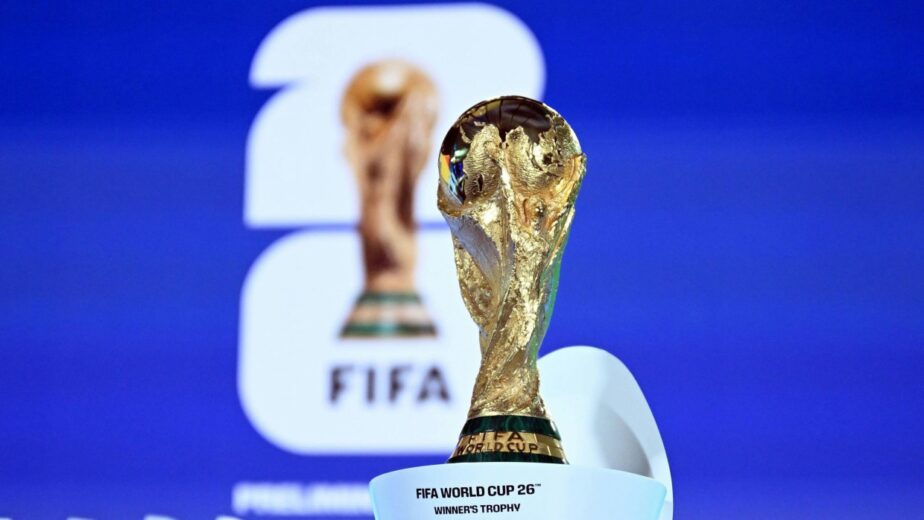
The 2026 FIFA World Cup is eight months away, but bookmakers have already declared Spain the favourites for the tournament.
Kylian Mbappe’s France, Harry Kane’s England, and Vinicius Junior’s Brazil have also been named in the list of favourites.
Spain Favourites to Win 2026 World Cup, England Third
The 2022 FIFA World Cup saw a thrilling final between Argentina and France. Kylian Mbappe delivered in a once-in-a-lifetime performance, scoring a hat-trick, but it still was not enough.
The game finished 3-3 after extra time, and Lionel Messi’s Argentina won the penalty shootout and their third World Cup. The reigning champions, Argentina, are surprisingly not one of the top three pre-tournament favourites to defend their title in 2026.
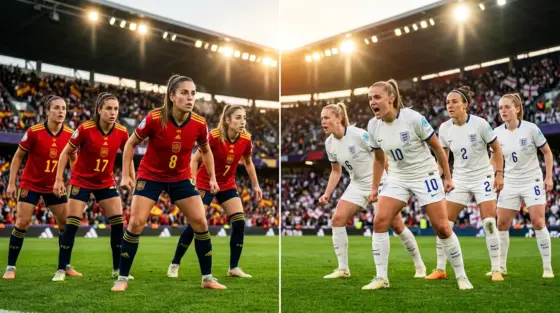
The pre-tournament favourites tag this year lies with Spain, with an odds-based implied probability of 19% (via PolyMarket). Two-time winners France are in second place at 13%, closely followed by England at 13%. Record five-time winners Brazil are fourth with an implied probability of 12%.
Messi’s Argentina are only the sixth favourites this year at 9%, trailing Cristiano Ronaldo’s Portugal at 11%.
World Cup 2026 Predictions: Top 10 Favourites
| Team | Implied Probability |
|---|---|
| Spain | 19% |
| France | 13% |
| England | 13% |
| Brazil | 12% |
| Portugal | 11% |
| Argentina | 9% |
| Germany | 6% |
| Netherlands | 5% |
| Norway | 4% |
| Italy | 2% |
Hosted across the United States, Canada, and Mexico, the 2026 FIFA World Cup is set to be the most expensive in history. The ticket prices for the 2026 World Cup final have seen a 479% jump from Russia 2018. Despite the steep hike, tickets have been flying off, pushing the prices even higher in the secondary market.
World Cup Betting Odds vs Reality: Bookmakers Have a 30% Success Rate
While Spain have every right to fancy their chances after their unbeaten run in EURO 2024, historical data suggests that the “favourites” tag does not count for much.
At the start of the 2022 FIFA World Cup, Brazil were the oddsmakers’ pre-tournament favourites at 22% implied probability. The Selecao crashed out of the quarter-finals after losing to Croatia. Winners, Argentina, were not even the second favourites.
Brazil were the pre-tournament favourites for the 2018 and 2014 World Cups as well. France won the competition in 2018, while Germany lifted the trophy in 2014. Bookmakers’ last success came in 2010, when pre-tournament favourites Spain won the World Cup.
Refer to the list below to see the pre-tournament favourites and second favourites for the last 10 FIFA World Cup editions.
| World Cup Year | Favourites (Win%) | Second Favourites (Win%) | Winners |
|---|---|---|---|
| 2022 | Brazil (22%) | France (15%) | Argentina |
| 2018 | Brazil / Germany (20%) | France (14%) | France |
| 2014 | Brazil (27%) | Germany (17%) | Germany |
| 2010 | Spain (18%) | Brazil (16%) | Spain |
| 2006 | Brazil (29%) | England (13%) | Italy |
| 2002 | Argentina (22%) | Brazil (16%) | Brazil |
| 1998 | Brazil (25%) | France (14%) | France |
| 1994 | Brazil / Germany (22%) | Italy (15%) | Brazil |
| 1990 | Italy (25%) | Germany (17%) | Germany |
| 1986 | Brazil (25%) | France (20%) | Argentina |
Interpretation of the Data
The pre-tournament favourites have only gone on to win three of the last 10 World Cups, establishing a success rate of 30%. Spain won it in 2010 and Brazil in 2002 and 1994.
Second pre-tournament favourites, meanwhile, have been successful four times, implying a 40% success rate. France (2018, 2022), Brazil (2002), and Germany (1990) were the second favourites going into the respective tournaments. Argentina (2022, 1986) and Italy (2006) were not among the top two favourites.
Combining the two, we get a 70% success rate, which is pretty decent considering how unpredictable football is. In 2026, a record 48 teams will participate in the tournament, making it even harder to call. But based on historical data, we believe it is worth keeping a close eye on the top three: Spain, France, and England.