

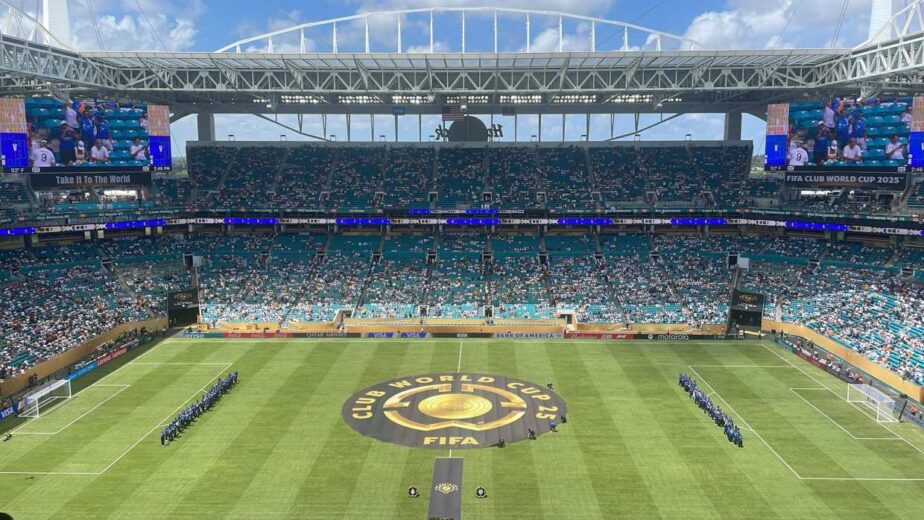
FIFA promised a month-long fiesta in the United States, with 32 teams squaring off in the new and supposedly improved Club World Cup.
The tournament started on a fine note, with fans filling the seats as Lionel Messi-led Inter Miami battled Egyptian club Al Ahly at the Hard Rock Stadium in Miami. But since that exciting but ultimately inconclusive goalless stalemate, attendance figures have primarily been disappointing.
Club World Cup Attendance Hovering Only Around 52%
Thanks to the growing popularity of football (or soccer) in the United States, FIFA expected sold-out venues throughout the Club World Cup. However, according to the latest data from FIFA, only 52% of tickets have been sold on average. This, however, does not guarantee 52% average attendance. As per the Guardian, the median attendance for the 2025 Club World Cup has only been around 43%.
This attendance issue grabbed the spotlight earlier this week when Chelsea faced LAFC at the Mercedes-Benz Stadium in Atlanta. Just around 22,000 fans turned up for the Premier League side’s Club World Cup opener at the 75,000-capacity stadium. Coach Enzo Maresca complained about the “strange” atmosphere after his side’s 2-0 win.
I count 97 people at Ulsan vs Mamelodi Sundowns here in Orlando
This has to be the worst attendance of the 2025 FIFA Club World Cup so far? pic.twitter.com/2TkHskwMC4
— Maher Mezahi (@MezahiMaher) June 17, 2025
Considering how poorly attended Chelsea’s game was, there was little hope for the game between Ulsan Hyundai and Mamelodi Sundowns. According to official figures, 3,412 people turned up at the 25,500-seater Inter & Co Stadium in Orlando.
Manchester City, the other Premier League club at the Club World Cup, also played in front of a sparse crowd. As per FIFA, 37,446 fans came for their clash against Wydad, filling just over 50% seats.
Top Five Reasons Why Club World Cup Games Are Being So Poorly Attended
Several reasons have contributed to the glaringly poor attendance figures at the FIFA Club World Cup. SportsCasting takes a look at the biggest ones.
Initial High Cost of Tickets
FIFA expected Club World Cup tickets to fly off the shelves. So, the initial ticket prices were out of reach for many.
When the tickets initially went on sale in December, the cheapest tickets for the opening game between Inter Miami and Al Ahly cost $349. Much to the dismay of FIFA, there were very few takers, and as a result, they had to reduce prices drastically to fill the stadium.
According to The Athletic, FIFA provided a special deal for college students ahead of the opener. In addition to selling a ticket for just $20, fans could get up to four complimentary tickets. General admission tickets, as per Ticketmaster, dropped to just $55, observing an 84.2% drop.
Shockingly low turnout for Real Madrid at the Club World Cup.
With barely any fans in attendance, event organizers were forced to hand out free tickets outside the stadium just before kick-off. pic.twitter.com/xjGtYQHyka— Kwabena Kissi🥷 (@JamaicaMafia) June 18, 2025
Had FIFA priced them reasonably from the beginning, more fans, especially from outside the country, would have been encouraged to attend.
Poor Stadium Selection for Games
FIFA have gone big with the Club World Cup, picking the largest possible stadium in an area. This has made even decent crowds appear sparse, taking a toll on the atmosphere.
The game between Borussia Dortmund and Fluminense was held at the 84,000-seater MetLife Stadium. Fans turned up in numbers for the game, but only filled half the stadium. Had the match been held at the 25,000-capacity Sports Illustrated Stadium, it would have been a jam-packed affair.
Major League Soccer (MLS) clubs have been using this strategy for a while now. Instead of going for the biggest stadium, they prefer to hold their games at more humble venues, elevating the atmosphere.
Inconvenient Match Times at the Club World Cup
The FIFA Club World Cup also suffers from poor scheduling for weekday fixtures. To make the kick-off times more convenient for European/Asian audiences, many Club World Cup games have had unusual kick-off times.
For example, the match between Chelsea and LAFC was on Monday afternoon, right in the middle of a workday. The fact that it was still attended by over 22,000 people was a win in itself.
A look at the crowd for the Chelsea-LAFC match in Atlanta, GA…😬 pic.twitter.com/x9qrXQdo9P
— Football on TNT Sports (@footballontnt) June 16, 2025
Failure to Solve the Demand and Supply Problem
Spoiled by the fanfare the World Cup enjoys, FIFA expected every Club World Cup game to be a sell-out. FIFA failed to gauge the difference between club and international football.
In the World Cup, players leave their all on the pitch, knowing it is a chance to attain immortality. The stakes are not nearly as high at the Club World Cup. At least not in the first iteration of the tournament.
🇦🇷 Maradona's first #FIFAWorldCup goals!#OTD pic.twitter.com/tmRH3nVTfn
— FIFA World Cup (@FIFAWorldCup) June 18, 2025
The UEFA Champions League remains the biggest club competition in the world. Except for a more lucrative payout, the Club World Cup does not have anything on the Europe-only competition.
The prestige UCL enjoys is primarily due to its relevance over the decades. Expecting a new tournament to soar as high in a non-footballing country was an overreach for FIFA.
Logistical Hurdles
The United States has a pretty stringent Visa policy, discouraging international fans from taking the plunge. For fans of most lesser-known clubs, the commute to the US did not make much sense.
Additionally, due to ongoing raids, immigrants have avoided attending such high-profile events.